
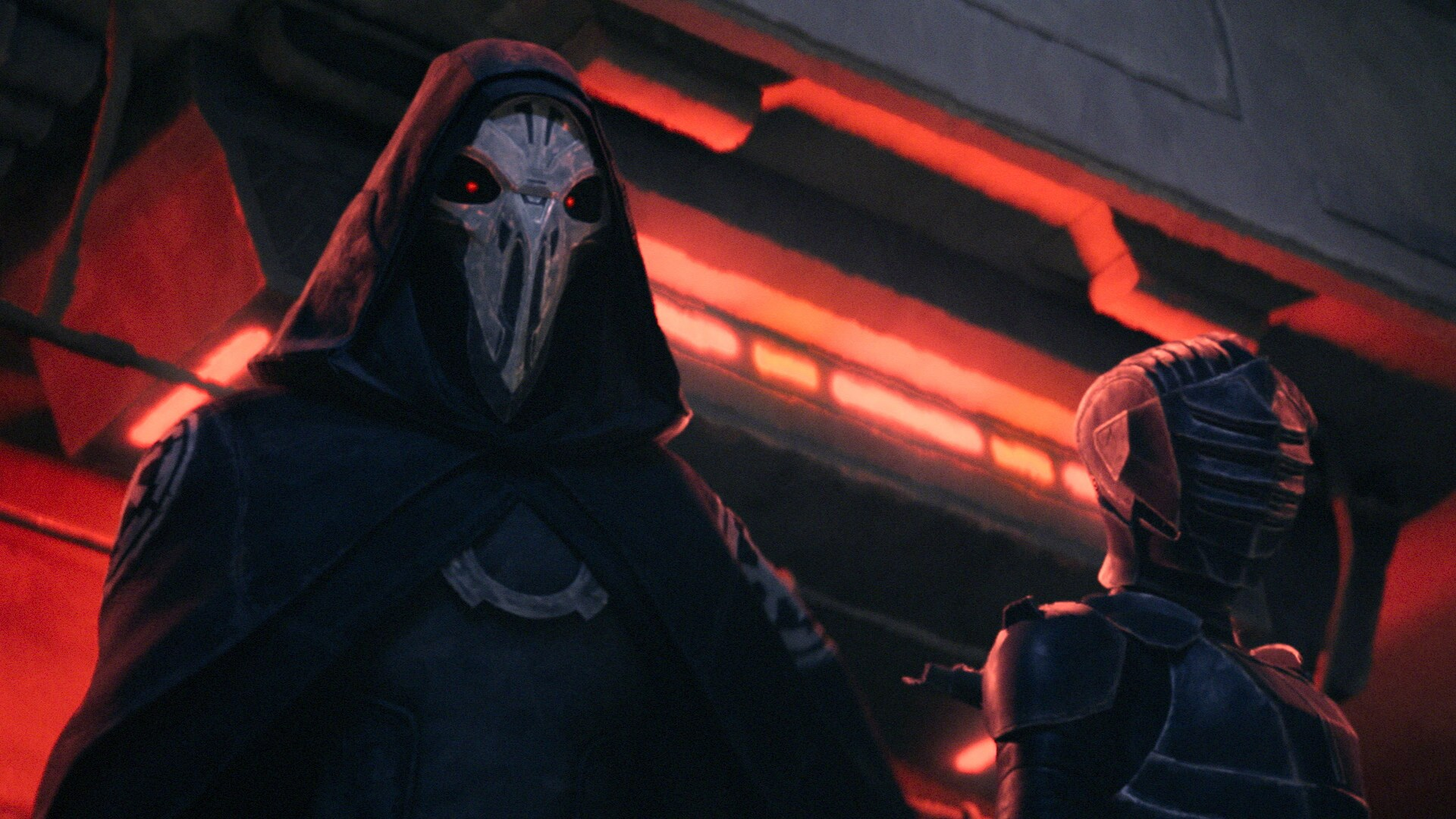
Star Wars television has a habit of uneven storytelling, and the seventh and eighth episodes of Maul – Shadow Lord are a good example of that. Some characters benefitted from solid writing that left me excited to see what happens to them next. Other characters — well, really just one very important one — got only muddled development. Overall, though, these two episodes were a nice continuation of the story, with a good balance of action and introspection.
Devon backs away from the brink(?)
Given the way that episode 6 ended, I really expected Devon Izara to start reevaluating Maul and, by extension, reconsidering her faith in the Jedi. But as episode 7 begins, Devon is still the same honorable Jedi she’s been throughout the entire show. She still dislikes and distrusts Maul, telling Rylee that he’s “not our friend, he’s a murderer.” (A glowering glance from Maul reveals that he’s none too pleased with Devon’s moral fortitude.) And she’s still loyal to her master, Eeko-Dio Daki, refusing to leave Janix without him despite Maul offering her a way out. Both of these moments are good signs for her continued adherence to the light side. I wouldn’t say I expected any of this after the events of episode 6, but as someone who’s rooting for Devon to stay on the right path, I sure am glad to see it.
Despite Devon’s aversion to Maul, she astutely realizes that sticking by his side is the safest thing for her and Rylee to do, at least for a little while. With Marrok the Imperial Inquisitor scouring the city for both Maul and the Jedi, Devon needs all the protection she can get, and Maul’s combat prowess is undeniable. The Jedi Council probably would have discouraged Devon from spending even a few minutes by Maul’s side, lest his sinister exhortations worm their way into her head. But as we’ve seen repeatedly in this show, Devon doesn’t have the luxury of taking clean, principled stands anymore. Accompanying Maul might be risky, but Marrok is the bigger threat. Credit to Devon here — she’s being more strategic and thoughtful than I’d expected her to be after the end of episode 6.
Still, Devon displays some worrisome tendencies in these two episodes. After Maul catches her and Rylee trying to escape, he uses the Force to freeze her in place, which leads her to unleash a primal scream as she breaks free and charges at him with her lightsaber. Devon might abhor everything Maul represents, but her emotional volatility is pushing her closer to Maul’s terrain than she probably realizes. Later, after the Empire captures Rylee and Devon reunites with Daki and Lawson, she insists that they rescue Lawson’s son. When Daki says the Jedi should leave and just hope the Empire releases Rylee, Devon scoffs at that idea, once again demanding action and confrontation rather than disengagement. (Admittedly, Daki’s idea is pretty naive.) When Lawson says he’s going to rescue his son, Devon says she’ll help him, without asking Daki’s permission. It’s Lawson who turns to Daki for approval — and as he does so, Devon gives her master a disappointed, almost angry look. Here again we see Devon’s impulsive need to act, to respond, to uphold justice. The fact that Rylee’s only in danger because Devon failed to protect him only heightens her sense of urgency. By now, Devon’s stubbornness is nothing new, but this moment, in which she lets her emotions cloud her judgement, is a reminder that the door is still open for her to fall to the dark side.
As a side note, Devon’s decision to run forward and help Maul repel the Imperial troopers — instead of escaping with Rylee, which had been their top priority a few seconds earlier — felt forced. Devon didn’t join Maul afterward, so it wasn’t about a change of allegiance. It seemed like the only purpose of that moment was to distract her so the Empire could capture Rylee. (Indeed, as soon as Rylee’s taken away, Devon stops helping Maul fight the troopers, as if she’s just remembered her priorities.) Surely there was another way to accomplish that story goal without such weak writing. Oh well.
Devon’s lapse in judgement does, however, lead to a great interaction between her and Rylee. As the heroes walk toward what they believe to be their escape route, Devon apologizes to Rylee for failing to protect him. Thanks to great animation and voice acting, this moment feels genuinely emotional — you can tell that Devon took her master’s assignment to protect Rylee very seriously and deeply regrets letting both of them down. Rylee, who clearly doesn’t want to be seen as a helpless child (I laughed at him bristling at Devon calling him a “boy” at the beginning of episode 7), tries to make Devon feel better by saying that it was his own fault for getting caught. But Devon surely knows that it was her fault. Perhaps she’ll meditate on how her impulsive rush to help Maul distracted her.
One of the exciting things about Maul – Shadow Lord is that Devon’s behavior gives you just as many reasons to trust her as it gives you to worry about her. One of the more encouraging moments happens toward the end of episode 8. When Rylee admits how scared he was of the newly arrived Eleventh Brother during his interrogation, Devon displays commendable wisdom and maturity, telling Rylee, “Fear is natural. We just can’t allow it to control us.” She’s clearly absorbed one of Daki’s most important lessons. I just hope she can keep following her own advice.
Maul’s dark (side) night of the soul
It’s a running joke at this point that Maul himself is the least interesting part of Maul – Shadow Lord, but in episode 8, the writers finally decided to try to do something moderately interesting with him.
Two notable moments in episode 7 prime Maul for the existential crisis that we see him undergo. First, Maul tells Devon that while Darth Sidious’s betrayal of him was “devastating,” it wasn’t “the deepest wound” he would deal him — a reference to Sidious’s killing of Maul’s brother Savage Opress, and a sign that Maul is still grief-stricken about Savage’s death. Then later, when the two Inquisitors are about to finish Maul off, one of his Nightbrothers swoops in and sacrifices himself to give Maul time to get back on his feet. As with Savage, Maul almost seems to mourn the Nightbrother’s death. And by the end of episode 7, the weight of everything he’s lost has put him in a resentful mood.
As Maul wanders miserably through the Janix sewer system, he goes on a psychological journey that transforms how he sees himself. This journey is the emotional heart of Maul’s story — such as it is — in the show, and by that standard, it’s something of a letdown, with little of the weightiness you’d expect from the titular character’s climactic story moment.
Maul’s journey revolves around his attitude toward his childhood self, the little Zabrak boy who made such easy prey for Sidious. Early in episode 8, Maul sees a reflection of his younger self in a puddle of water and lashes out at it resentfully, clearly ashamed that he wasn’t stronger in standing up to Sidious. Maul then takes a hallucinatory trip down memory lane in a dust-filled sewer tunnel, and we see flashes of his life story: Sidious taking Maul from his home, Sidious ruthlessly training a young Maul, Maul’s death at Obi-Wan’s hands in The Phantom Menace (although not quite the way it happened, choreography-wise), Savage encountering a resurrected Maul in The Clone Wars, and Sidious killing Savage. After confronting these memories, Maul has a change of heart about his younger self. When another reflection of the little boy apologizes to him, he tearfully responds that the child — that he himself — has nothing to be sorry for.
In what is supposed to be a major turning point for Maul, we see that he no longer shamefully rejects the memory of his younger self. Instead of resenting how weak he was as a child, he now recognizes that it wasn’t his fault. He didn’t fail; the galaxy failed him. And as his emotional odyssey ends, Maul vows to not let Sidious corrupt any more children.
All of this is supposed to further explain Maul’s vendetta against Sidious, which we later see him pursue in Rebels. To be honest, though, it kind of backfires. We already understood the reasons for Maul’s anger at Sidious; that vendetta didn’t need any more justification. The only thing the epiphany sequence does, with its focus on Sidious’ depravity, is undermine the story logic of Maul continuing to pursue his vendetta against Obi-Wan. After everything Maul has experienced in the Janix sewers, we’re really supposed to believe that he still thinks his time is well spent going after a Jedi hermit? It makes no sense. Far from being a narrative triumph, the epiphany storyline feels more like self-sabotage when you remember what Maul goes on to do.
And there’s another weird thing about the vision-quest sequence. If Maul’s visions were just supposed to teach him that he couldn’t have stopped Sidious from corrupting him, that would be fine. I understand that element of the story here. But that’s not the main lesson that Maul seems to take from the visions. Immediately after seeing them, he mutters about losing his home, family, and brother, and then he blames Sidious, as if Sidious’s culpability is a revelation to him. But both he and we already knew Sidious was responsible for all of that. Maul even starts out the show resenting Sidious for it. So why does the show present this as a new discovery for Maul? Once again, it makes no sense.
Regardless of how incoherent Maul’s epiphany is, it leaves him with an even more single-minded purpose, and I’ll be curious to see how that mindset affects his grand plans. Episode 7 showed us that he was already ambitious to the point of myopic arrogance, delusionally telling Devon that he could defeat the Empire himself and brushing off his commandos’ disgruntlement by professing confidence that “every move we make is in accordance with a greater plan.” How will his renewed hatred of Sidious shape what he does next?
Miscellaneous thoughts
- I remain very impressed by Gideon Adlon and Wagner Moura’s performances as Devon Izara and Brander Lawson, respectively. They’re incredibly believable, relatable, and compelling characters. I feel like I’ve known them for far longer than eight half-hour episodes. I root for them, worry about them, and sympathize with them. I never expected this show to excel so much at character development.
- As Lawson and Daki creep through back alleys at the beginning of episode 7, the police captain is unusually antsy. When he suggests that they hurry to find Rylee, whom he feels guilty about not protecting, Daki discourages hastiness and warns Lawson not to let his regret consume and distract him. Daki is surely worried about his young charge, too, but he’s more in control of his emotions and more mindful of the fact that impulsiveness leads to fatal mistakes. His warning to Lawson is another version of the “we can’t let fear control us” lesson that he’s taught Devon (and that she later conveys to Rylee).
- Lawson tells Daki that he worked with a Jedi years ago and doesn’t believe what the Empire said about them being traitors. It’s a nice reminder that fugitive Jedi still have quiet allies in this era, even as danger lurks around every corner.
- In every confrontation between the Empire and Maul’s gang, I continue to be amazed that the totalitarian galactic government can’t muster enough strength and firepower to take on a ragtag band like Maul’s devotees. How are a single rocket launcher and a single machine gun enough to consistently defeat waves of Imperial troopers?
- I continue to be exasperated by the jarringly static painted backdrops that Lucasfilm Animation loves using in this show. Three examples are particularly galling: The sky behind Marrok in his first scene in episode 7, the landscape in the scene where Marrok greets the Eleventh Brother, and the scene in episode 8 where Maul’s gang visits Nico Deemis’s office. No disrespect to the talented artists creating these static backgrounds, but they simply don’t work in such high-quality animation.
- We very rarely see dark-siders dueling each other, so Maul’s duel with the two Inquisitors is a nice change of pace. I like seeing how Maul’s feral fighting style (complete with animalistic screams) differs from the more confident and controlled style of his opponents.
- Episode 8 finally pays off the … subplot? I guess? about Maul’s increasingly disgruntled Mandalorian commandos. Unsurprisingly, they mutiny. I assumed they’d get away, but of course the Empire has the skies covered, and their escape is soon cut off by a volley of gunship missiles. To be honest, that whole story thread felt pretty pointless — if the goal was to deplete Maul’s forces, why give him the commandos in the first place? It’s not like they needed to be there to ensure his earlier victories — as I mentioned above, there was very little story logic to how those victories unfolded.
- After a series of indignities and alarming experiences — being forced to abandon his trademark boots; being threatened with a memory-wipe for insisting on following interrogation protocols; discovering that the Empire killed Chief Klyce in violation of investigative procedures — Two-Boots finally turns on the Empire, frees Rylee, and helps the heroes escape. Perhaps Lawson’s selfless concern for his son is what finally convinced Two-Boots that he was on the wrong side. In any event, they have a really sweet reunion moment, as Two-Boots asks, “How did you know it was me? I’m not wearing my boots,” and Lawson replies warmly, “Partner, I’d know it was you any day.” Happily, their friendship endures despite the recent tensions.
- I’m really impressed by Devon’s fighting ability. She’s remarkably proficient for someone who’s been in hiding for years.
- The speeder escape sequence in episode 8 is wonderfully kinetic, with great camera work, music, and action choreography. My favorite shot in the sequence is when the speeder races out of the tunnel and a gunship soars up in front of the fast-moving camera. The energy of the shot really makes you feel like you’re in the cockpit with them. This is followed by a shot of the speeder careening over a railing in a moment that goes grippingly silent until the speeder hits the level below. Another thrillingly chaotic moment is when Daki Force-hurls a speeder bike into the side of a hovering gunship and Devon throws their speeder into overdrive to avoid the crashing vessel.
- Rook Kast’s behavior in episode 8 makes no sense. After wisely saying that it’s time for Maul’s gang to leave Janix, she later tells Vario that they’ll “wait as long as it takes” on Janix for Maul to find them.
- The silent and sinister Eleventh Brother is a great addition to the story. The arrival of a second Inquisitor underscores how seriously the Empire is taking the threat that Maul poses. I also like how Rylee refers to an Inquisitor as a “thing,” highlighting how terrifying they are to regular people.
- Shoutout to Rheena Sul for risking her life to sabotage the trap that the Empire planted for the Jedi and their allies. It seems unlikely she’ll survive that.
- Episode 8 ends with Maul learning that Dryden Vos of Crimson Dawn wants to meet. The writers are starting to set up the dynamic of the criminal underworld seen in Solo. But given everything that the show has done to bring Maul and Devon together, I can’t imagine that he’s going to go meet Vos without tying up loose ends on Janix first.