
As Maul – Shadow Lord’s first season passes its halfway mark, the show is firing on all cylinders. Episodes 5 and 6 do a fantastic job of showing the desperation of Jedi on the run, the difficult choices facing civilians living under tyranny, and the ruin that the Empire brings everywhere it goes. With stellar character development, pacing, camera work, and choreography, these two episodes were some of the best Star Wars television I’ve ever seen. And as usual, Maul is the least interesting part of his own show.
Jedi at odds
As episode 5 begins, Devon Izara appears to be growing more and more skeptical of her master Eeko-Dio Daki’s insistence that they flee Janix. Devon wants to deal with Maul, presumably worrying about the chaos he’ll be free to cause if they leave him behind. But Daki tells her that Maul is “no longer our concern.” Instead, he says, their job is now to survive. Daki is being prudent — the Jedi can’t afford to think like they used to, not with the entire galaxy turning against them — but he’s not doing himself any favors with his apprentice.
As the Jedi continue evading Imperial troopers, they once again butt heads over what the new galaxy means for them. Devon doesn’t want her future to be a series of last-minute escapes from capture. In response, Daki is all pragmatism: “If it means our survival,” he says, “we do what we must.” (I’m sure it’s no coincidence that this line is almost identical to Maul’s comment to Devon in episode 3: “We do what we must to survive.”) And then at last, subtext becomes text. When Devon says hiding sounds like a waste of their abilities, Daki observes that she’s sounding more and more like Maul. It’s an ominous moment, highlighting tensions between the two Jedi that make their already precarious situation even more fraught.
By now, it’s clear that Maul’s strategy has successfully unsettled Devon. She doesn’t understand why Maul wanted to team up with the Jedi rather than killing them. It seems out of character for the monster she’s heard about. She even says that Maul “may have a point about the Empire” — that Force users should team up to defeat it. Obviously, she’s starting to rethink what she’s been told about Maul. Daki does his best to keep her on the right path, arguing that Maul’s affability is a ruse and that devotees of the light side of the Force can never ally themselves with someone like Maul. But Devon is clearly unpersuaded.
With Devon Izara, Maul – Shadow Lord is reinforcing the message that the prequel trilogy tried to convey: that greedy, amoral people aren’t the only ones vulnerable to the pull of the dark side, and that sometimes, the road to hell is paved with good conditions. Devon wants to right injustices and sees hiding in the shadows as a waste of her ability to help people, and she’s too headstrong to listen to the people warning her to be careful. As we saw in the prequel trilogy, the Jedi, with their placid, staid admonitions about the dangers of impulsivity, are poorly suited to reining in stubborn young people who think the ends justify the means.
As Daki and Devon walk through the subway system, the master reassures his apprentice that tyranny is temporary and the Jedi just need to hope for a better future. But Devon isn’t convinced by Daki’s reassurances. She wants to act, not hope. And as with Anakin Skywalker before her, that attitude is likely to be her undoing.
The Lawsons pass the breaking point
As master and apprentice are hashing out their differences over their next steps, Captain Brander Lawson’s world is about to fall apart.
The show does a really good job of depicting how the Empire’s arrival on Janix throws Lawson’s life into chaos. The whole Imperial arrival sequence is really well done: the shadows of gunships flying over the urban landscape, the people looking up apprehensive at the passing ships, the faceless hordes of troopers marching in lockstep down shuttle ramps and across plazas, the dispassionate public-address announcements urging order and compliance, the intrusive new ID checks at the sports stadium, the Star Destroyer looming large out the police station’s window. But you also see the disruption in little moments, like when we hear Lawson’s heart thud in his chest as he looks anxiously around the occupied police station. That simple use of sound and perspective was a great window into his simmering frustration.
The Empire’s presence also scrambles things for Lawson’s son Rylee. As he sees the Empire up close, he knows enough to be alarmed. But in desperation, and with his father unavailable, he calls the wrong person for help: his mother, who, as we’ve learned, works for the Empire. Unlike almost every other sympathetic character we meet in Maul – Shadow Lord, Rylee’s mother sees the Empire as a benevolent force for order. A close examination of her brief conversation with Rylee shows what thorough fascist brainwashing can do to an otherwise good person. When Rylee’s mother learns that the Empire is interrogating Lawson, she reflexively blames her husband. She’s so deep in the Imperial system that she can’t fathom the idea of that system being an oppressor, much less a direct menace to her family. Instead, she seeks comfort in the Imperial propaganda about innocent people having nothing to fear from the Empire’s heavy-handed tactics. “If troopers are there,” she tells Rylee, “then it’s to keep everyone safe.”
To his credit, Rylee doesn’t believe his mother’s reassurances. What she’s saying is too at odds with what he’s seeing firsthand — another reminder of why fascism seeks to suppress, rather than promote, the truth of its deeds. For decent, honest people, seeing oppression up close is a radicalizing thing. As events on Janix conspire to completely upend Rylee’s life, he’s already starting to question his assumptions about the galaxy — and, perhaps, about his mother and father’s different worldviews.
Seeing the Jedi through civilian eyes
Maul – Shadow Lord does a better job than almost any other Star Wars story of showing us what happens when the desperation of hunted Jedi collides with the reluctant morality of civilians just trying to keep their heads down. That dynamic has been ripe for exploration ever since Lucasfilm started telling stories set during the rise of the Empire, but episodes 5 and 6 of Maul – Shadow Lord feel like the first time the premise has lived up to its potential.
Daki’s decision to put the Lawsons in danger by taking refuge in their apartment is a stark illustration of how hiding from the Empire is changing the Jedi who survived Order 66. During the Republic era, Jedi would do anything to avoid endangering civilians. But now that the Empire is hunting them, they don’t have the luxury of that noble-minded approach. (Or perhaps Daki figures that Lawson is already “in it” enough to not qualify as a civilian.) You really feel for Daki as he tries to convince Lawson to help him and Devon. He’s not used to being in that situation — the vulnerable party, asking for protection from an overwhelming threat. He’s used to being the one offering that kind of protection.
Lawson, meanwhile, says he can’t help the Jedi because he has to think about his son. This must happen all over the galaxy when fugitive Jedi ask people for help. The civilians’ fear is real and understandable — indeed, their recognition that doing the right thing could have fatal consequences is one of the most sinister things about Imperial rule. In case you can’t tell, I absolutely love seeing these aspects of the Jedi’s struggles during this era.
While Daki and Lawson talk about the brutal reality they face, Rylee and Devon hang out awkwardly in Rylee’s room. It’s the last quiet moment in episode 6, and it’s a great scene. Both children are self-conscious about being in a situation they’re not prepared for. (Rylee hurriedly cleaning up his room because a girl is there is really funny.) And at the root of the awkwardness is a massive gulf between them that stems from their very different upbringings. When Rylee says Devon must not have grown up like him if she doesn’t know bodekin, Devon dryly says her childhood was indeed very different from his. The whole scene is a wonderful reminder of how different the Jedi are from everyone around them. It’s something we saw a few times with Ahsoka Tano in The Clone Wars, but this instance of it feels sadder somehow — perhaps because seeing an example of the Jedi’s “otherness” during the early Imperial era reminds us that their studious isolation made it easier for Darth Sidious to marginalize and persecute them.
But suddenly there’s no more time to reflect like this. From the moment the Inquisitor Marrok’s crimson lightsaber blade pierces the door of Lawson’s apartment, episode 6 picks up its pace dramatically, with the rest of the story unspooling breathlessly across the foreboding landscape of Imperial-occupied Janix. I did not at all expect how quickly things would escalate at this point, but it was great to see.
As the Lawsons flee their home and fire consumes the lone holo-image of their whole family, you really feel for Captain Lawson and his son. In the blink of an eye, they’ve lost everything, and all because Lawson was a good enough guy to make a connection with a Jedi.
Rylee’s confusion is palpable as he tries to process what’s happening around him. When his father shoots at troopers on a hovering gunship, he can’t believe what he’s seeing. I really like these glimpses into the lives of regular people during the Empire’s consolidation of power. It makes total sense that Rylee would regard shooting at troopers the way someone in the real world might regard shooting at police officers. Hey, those are the good guys! They’re on our side! But what happens when you realize that you’ve been on a different side the entire time? As they flee their apartment block, Lawson tells Rylee, “The Empire isn’t what you think it is.” It’s so exciting to see that kind of conversation between father and son in Star Wars — especially when their other loved one works for the Empire. I love how Maul – Shadow Lord is exploring this dynamic.
It’s not just the show’s dialogue and plot that bring you into the lives of civilians trapped between Jedi and Empire. The cinematography does a great job of this too. There are some really great shots of the Jedi fighting Marrok or the troopers while the Lawsons watch from the background and dart between cover. In one shot, as Devon deflects blaster bolts from troopers on the gunship, a bolt hits a pipe near the Lawsons’ heads, and you get a visceral sense of how dangerous it is to be near a shootout like that. These moments show us the Jedi’s power and heroism from a civilian’s perspective — something we don’t often get — but they also show the civilians themselves just trying to stay safe in a world turned upside down by the presence of Force users.
While I’m singing the praises of the camera work, I’ll mention another great example of the use of perspective: As Lawson and Daki fend off troopers in Rheena Sul’s office, our view of the fight begins to be obscured as the camera descends with the elevator, suggesting we’re seeing the chaotic scene through Rylee’s eyes.
The enemy of my enemy
As a big fan of public transit, I was thrilled to see episode 6’s climactic fight take place in Janix’s subway system.
As Marrok stalks into the train station, Devon stutters as she tells Rylee to flee on the train, and there’s strain in her voice as she repeats her command. Actress Gideon Adlon’s performance brilliantly conveys Devon’s combination of primal fear and stubborn resolve. In that moment, Devon may be a terrified child just like Rylee, but she’s also a highly capable warrior, and she’s going to defend Rylee until her dying breath, because that’s what a good Jedi does.
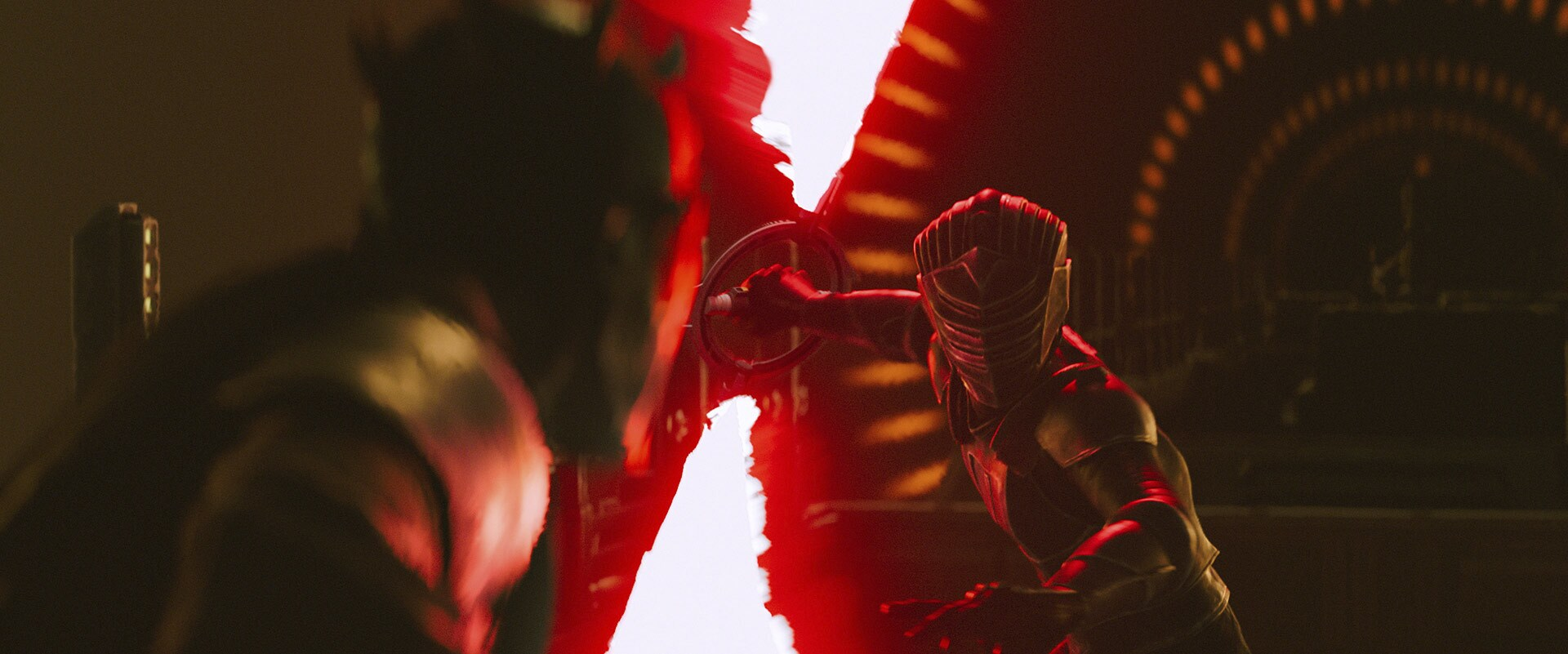
Of course, plot requirements don’t allow Marrok to kill Devon yet, so she has to hold her own reasonably well until Maul shows up. But the fight choreography does a good job of showing that Marrok is more powerful and better trained than Devon, even as she scrambles enough to survive. When Maul arrives, the contrast between his and Devon’s fighting abilities is pronounced. He’s much more confident and controlled as he duels Marrok, and you get the sense that they’re evenly matched. The rest of the fight unfolds with wonderful dynamism, including a moment where Marrok, while dueling Maul, casually Force-throws a pile of crates at Rylee, forcing Devon to push Rylee out of the way.
The fight finally ends when Devon severs the connection between two train cars, leaving Marrok watching with surprising helplessness as the train carrying Maul, Devon, and Rylee recedes into the distance. But the end of the fight marks the beginning of a new phase of the drama, because now Devon has to decide what to do about Maul. At first, she turns her lightsaber on him, implying a willingness to fight. But her heart isn’t in the gesture, and after he backs away from her, she deactivates her blade.
A good Jedi would fight Maul to the death rather than let him live to keep menacing the galaxy, but Devon doesn’t do that. Despite all of her master’s warnings about Maul, she seems to be rethinking the role he’s playing in the galaxy — and the role he could play in her life. In short, Devon appears ready to make a deal with the devil. And judging by episode 6’s ominous final scene — in which Marrok contacts an unknown superior to report that Maul and the Jedi have teamed up — Devon might soon be facing a much more powerful enemy.
Miscellaneous thoughts
- Shoutout to Chief Klyce for not letting Lawson take the blame for covering up Maul’s presence on Janix. She proves to be a loyal ally to Lawson, apparently paying the ultimate price under Imperial interrogation rather than giving Lawson up.
- I love Lawson’s face when Klyce says “It’s not like we were harboring Jedi.”
- Until Imperial Lieutenant Blake’s arrival, I didn’t even think about the fact that Janix would get in trouble for not immediately reporting Maul to the Empire. Naturally that would raise all kinds of suspicions once the Empire found out. Of course, Blake is wrong that Janix covered up Maul’s presence to protect him, but fascism doesn’t care about the truth.
- Is Maul’s lieutenant Rook Kast starting to lose faith in him? She seems exasperated with his fixation on Devon. We also see her Mandalorian commandos complain to her about now having to fight the Empire. I wonder if Maul’s about to lose his army…
- I love the moment where Lawson sees the nail scratches on the interrogation room’s table and realizes that something brutal happened in there. It’s followed by an equally great moment as Marrok emerges from the shadows and demands answers.
- It seems like the show is setting up Two-Boots to have a heroic change of heart about the Empire. He’s initially pleased to see Imperial forces arrive, viewing them as honest law enforcers and even telling Rylee not to worry about his father’s interrogation. But his appreciation for the Empire’s focus on order and efficiency appears to take a hit when Lieutenant Blake tells him to remove his non-regulation boots. I don’t expect Two-Boots to change his tune over something so petty, but hopefully it’s the first of many signs that he’s on the wrong side.
- I love the scene where Marrok investigates the scene of Maul and Lawson’s confrontation and, as he brushes his hand along the damage, you hear the echoes of the battle, including lightsaber slashes.
- I have to imagine the repeated moments focusing on Maul’s damaged mechanical leg are leading up to something.
- I like Lawson telling Rylee not to let Devon “steal anything” — a nod to the first time they met.
- Episode 6 gave us some of the most kinetic, exciting Jedi-on-non-Jedi combat we’ve seen in this era, like the moment during the apartment rooftop fight where Devon cuts down a trooper with her lightsaber and uses the Force to push another one.
- Lawson and the Jedi needing a covert evacuation from Janix is another illustration of how the Empire has inverted the natural order. Guardians of peace and justice now have to use criminal methods to escape a corrupted law-enforcement system.
- Lawson and Daki exhibit strong teamwork as they cut through Imperial troopers during their escape. They have some really good tag-team moments, and I love how the camera moves as it follows them through the casino parking garage.
- The visuals during the climactic train fight are excellent. The lightsaber blades flash brightly in the dark, confined space, and the racing tunnel lights accentuate the scene’s frenetic energy.
- I love the moment where Marrok turns on his lightsaber’s spinning feature and Maul activates his second blade in response, as if to say, “Guess what? I’m super extra too.”