
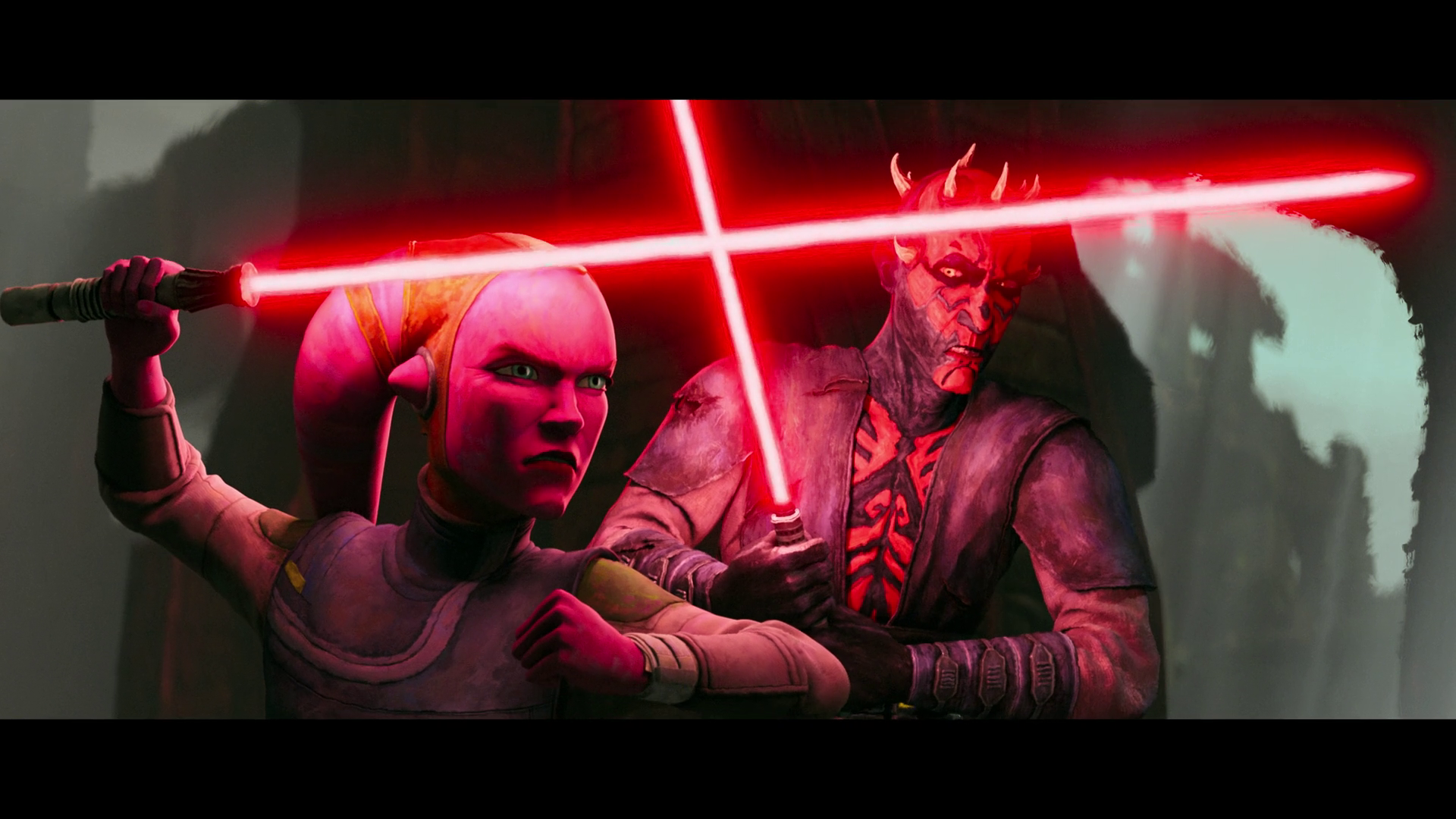
One of the prequel trilogy’s biggest problems was that, however compelling the depiction of Anakin Skywalker’s traumatic life story was, viewers could never really root for him to stay on the right path, because we knew he didn’t. In Maul – Shadow Lord, on the other hand, we met a Jedi who faced similar anxieties and temptations but had an unknown future ahead of her. Now that season 1 is over, it’s clear that one of its most impressive accomplishments was building up that Jedi to the point where viewers really cared about and rooted for her, even as many signs indicated that she was headed toward a tragic fate.
A necessary but fraught partnership
With Janix under Imperial lockdown and the Inquisitors on the prowl, Jedi Master Eeko-Dio Daki, Padawan Devon Izara, Captain Brander Lawson, his son Rylee, and their droid friend Two-Boots desperately need a way off-planet. Unfortunately for them, their best hope is their second-worst adversary, Maul.
I really liked this team-up, because it subverts the usual storytelling tropes about heroes and villains. We rarely see this kind of collaboration between such fierce antagonists, but it makes a lot of sense in this story, where the title villain isn’t actually the heroes’ biggest problem. At one point, Lawson tells Two-Boots to be alert for Maul to double-cross them as soon as they’re clear of the city, but to Maul’s credit, and in the face of bigger threats, the partnership lasts a lot longer than that. In fact, beyond simply not being their biggest problem, Maul has good reason to want the heroes to succeed. “I wish only to see you evade the Empire’s grasp with me,” he tells them when they all rendezvous for the first time. And while Maul obviously has other goals, too, there’s truth in his words. Maul and the Jedi are fighting the same enemy, and the Jedi’s presence in the galaxy causes chaos that benefits Maul. His team-up with the Jedi in episode 9 highlights the refreshingly unusual role he plays in this series: He might be a villain, but he isn’t the central villain of the story, and he doesn’t hate the Jedi the way most Star Wars villains do. In fact, he even seems to respect them.
Even Daki, who has been the wariest about Maul, recognizes that the Jedi and the Lawsons are better off at his side than anywhere else. But partnering with Maul also has a major downside: It puts Devon in close proximity to the man who has been trying to corrupt her for the entire season, now cast as their savior. The constant tension between Daki and Maul over whose influence on Devon will prevail adds a particularly rich layer to the whole escape routine.
As I said above, I’ve spent the whole season rooting for Devon to resist Maul’s enticements to the dark side. But from the very beginning of episode 9, things don’t look good on that front. Maul’s ability to telepathically communicate with Devon is a worrisome sign of their growing connection. Daki quickly warns Devon that Maul is manipulating her, but he has no choice but to put her at Maul’s side. And then we discover that Devon has been hiding her connection with Maul from Daki. As they walk, she reluctantly admits to her master that Maul saved her and Rylee’s lives from Marrok. Daki can see that this rescue led Devon to begin reevaluating Maul, and he tries to prevent that by asking her why Maul saved her — for her sake, or for his? Devon, tellingly, doesn’t respond; she cares more about the immediate fact that Maul’s helping them than about the longer-term question of what his goal is.
Three other incidents highlight Devon’s growing comfort with Maul. First, consider how she reacts after he destroys the Imperial walker during their escape from the city. She’s taken aback by the casual violence he inflicts, as if she can’t reconcile that display of aggression with her evolving view of him. Daki, who isn’t at all surprised by what Maul did, wears a grim expression that reflects his growing unease with his apprentice’s mindset. A similarly alarming sign presents itself later, when Maul tells Devon that his master was a Sith Lord. The revelation doesn’t seem to bother Devon nearly as much as it should — another sign that she’s already dangerously receptive to Maul. And finally, after the acid-pit battle, there’s Devon telling Maul that she’s sorry about all of his friends’ deaths. She seems to see him as having more emotional capacity than anyone else realizes. Maul, meanwhile, says nothing in response. Perhaps he truly is mourning his allies — or perhaps he just wants Devon to think he is.
Given what’s about to happen with Maul and Daki, I think it’s worth noting how the former treats the latter for most of their time together, because once again, it defies our expectations and subverts narrative conventions. When Rook Kast insults Daki, Maul rebukes her, reminding her that Daki is a Jedi master, with all of the experience and stature that that implies. Maul may dislike the Jedi’s code, but he’s still smart enough to respect a powerful Jedi when he meets one. This actually represents some growth for Maul, who previously blindly despised the Jedi because of Darth Sidious’s brainwashing. And more than just respecting Daki’s power, Maul recognizes that he needs Daki’s help. Of course, that doesn’t mean he’s indispensable to Maul. But still, we’re so used to villains treating Jedi a certain way that this uneasy partnership represented something fresh and interesting. I kept waiting for Maul’s betrayal of Daki and being surprised when he kept working with and even protecting the Jedi master. During the acid-pit battle, for example, Maul urges Daki to flee to safety while he holds off the two Inquisitors, which is exactly the opposite of what I expected.
Enter the monster
After Maul and his party escape into the Janix jungle, Marrok tells the Eleventh Brother to inform “him” that the heroes are headed “his way.” At this point, I was a little intrigued by Marrok’s cryptic reference, but I just thought he was talking about the Grand Inquisitor. I didn’t think there was any chance that the threat level on Janix could possibly get higher than that. But then, after an unseen adversary quickly dispatches Maul’s last remaining commando and (in a particularly violent-sounding moment) Rook Kast, the sound of iconic breathing breaks the eerie silence, a familiarly foreboding shape emerges from the mist, and the snap-hiss of a red lightsaber throws the entire story into chaos.
Darth Vader has arrived.
I can’t emphasize enough how much I wasn’t expecting this. Vader is such a titanic figure that he instantly dominates any story he appears in, which makes him difficult to use. At the same time, using him sparingly means that, when he does appear, he makes a huge impact. Nowhere is that more evident than in episode 10 of Maul – Shadow Lord, in which Vader bursts onto the scene as a mysterious, terrifying, and implacable force of nature.
Maul – Shadow Lord absolutely nailed Vader’s demeanor. He’s basically a horror-movie villain, right down to the jump-scare when he ambushes Maul and Daki by smashing his gloved fist through a stone wall. Both Devon and Maul call Vader “it,” further emphasizing his terrifying other-ness. And while the real reason Vader doesn’t speak in this episode is probably because Lucasfilm hasn’t yet decided how widely it wants to deploy its artificial intelligence clone of James Earl Jones, his silence adds a whole other level to his on-screen menace.
I also love how effortlessly Vader fights. All of his moves are precise and contained, revealing his supreme confidence and his unmatched command of the Force. He easily fends off three skilled Force-users, even simultaneously dueling the ferocious Maul and the powerful Daki almost entirely single-handedly. He scores a direct hit on Maul’s injured leg within seconds of appearing at the beginning of episode 10, underscoring his almost casual mastery of lightsaber combat. And while other characters swing their lightsabers in wide arcs to deflect blaster bolts, Vader turns to where they’ll be and blocks them with barely a twitch of his arm, showing his uncanny ability to anticipate attacks. And through it all, his helmeted visage adds an air of implacability to his presence. This might be the scariest Vader has ever felt to me.
Vader’s presence instantly makes all of the heroes seem small, even the venerable Daki. Only Maul can even remotely compare to Vader in terms of raw Force power, but even he’s alarmed by Vader, recognizing the threat he poses and ruminating on his enigmatic nature. “What are you?” Maul asks Vader at one point, in a great moment that highlights how much of a terrifying mystery Vader is to virtually everyone around him, from regular people like Lawson to the ever-confident Maul. And Maul is right to be unsettled — he’s no match for Vader. We’ve seen Maul easily handle virtually every threat he’s faced in this show and even hold his own against two Inquisitors until his mechanical leg failed him, but it takes Vader barely a few minutes to push Maul to the ground and almost kill him. We’re used to thinking of Maul as a force of nature, but Vader completely outclasses him and actually scares him enough to prompt him to retreat. It’s the perfect way of emphasizing just how indomitable Vader is, and it also nicely sets up Maul’s later fear of Vader in Star Wars Rebels.
Meanwhile, I can’t imagine what Vader’s thinking about Maul in this episode. Surely he remembers Maul as the wraith who almost killed him on Tatooine and then killed Qui-Gon Jinn on Naboo. By this point, though, he’s probably not mourning Qui-Gon as much as he’s thinking about Maul as a loose end for Sidious. Still, there’s an earlier moment where Maul tells the Inquisitors that Sidious is just going to dispose of them like he did with him, and I wonder if any part of Vader is thinking about the possibility of Sidious doing that to him as he’s fighting Maul.
Ironically, while Vader represents the biggest mortal threat that Maul has ever faced, he also presents Maul with the perfect opportunity to achieve his goals. As Maul and the Jedi catch their breath after their initial clash with Vader, Maul tells Devon that the only way to defeat the Sith Lord — who, he notes intriguingly, knows how Jedi fight — is to “let go of your restraint” and “tap into your rage.” Daki pushes back, saying they must “remain calm in the face of fear.” “True power,” he tells Devon, “lies in our patience and cunning.” (You actually see this dichotomy play out later when Vader, Daki, and Maul are squaring off. As Vader waits for the others to make the first move, Daki gestures for Vader to come at him, believing he’ll have the advantage on defense, but Maul gets tired of waiting and angrily charges at Vader.) As in previous episodes, Devon faces an existential choice between embracing Maul’s philosophy or abiding by her master’s — but this time, she’s mere minutes away from making her fateful decision.
Lawson’s noble end
While Maul and the Jedi deal with Vader, Lawson and his son are just trying to stay alive.
It’s easy to sympathize with Lawson as he and Rylee creep through Janix’s underbelly. Lawson used to be one of the arbiters of justice on the planet, and now he’s fleeing his home through the same secret passage where he once trailed a fugitive. Plus, his son is now in the middle of exactly the kind of violence that Lawson has spent his career trying to shield him from. There’s a great moment where Rylee stuns a trooper and Lawson looks at him with a mixture of pride and worry. He’s already put Rylee through so much, and he clearly regrets that it’s only getting worse.
Lawson and Rylee’s slow journey across the acid pit leads to a genuinely touching moment between father and son. “The things I was focused on just finally caught up to me,” Lawson says as he apologizes for how he’s raised Rylee and for putting him in danger. The sad moment reminds us that Lawson isn’t perfect, even if he is a hero. In many ways, Lawson is like a lot of fathers in the real world who struggle to balance competing responsibilities, and I always appreciate when Star Wars emphasizes its characters’ relatability.
As the skiff cruises across the acid pit, Rylee says the journey is the most time they’ve spent together in a while. That line beautifully sums up how bleak the Lawsons’ family life has been, highlighting the sacrifices that everyday heroes like Lawson make to do what they believe is right. And speaking of sacrifices, Lawson and Rylee’s heartfelt moment should have been a clue that tragedy was just around the corner.
In the Janix jungle, as Imperial troopers advance on Rylee and Two-Boots’ position, Lawson realizes that the best way to ensure his son’s safety is to distract the soldiers while Rylee flees onto Dryden Vos’s newly arrived ship. This moment genuinely tugged on my heartstrings — I’ve been a huge fan of Lawson for the entire show, so it was sad to watch him decide to give up his life for his son’s, but his decision made sense, and it underscored why I admire him so much. The animation does a fantastic job of conveying Lawson’s state of mind, as anxiety gives way to resolve, and the editing nicely contrasts Lawson’s virtuous realization of the need to sacrifice himself with Maul’s craven realization of the opportunity to sacrifice Daki. (Shortly afterward, the episode brilliantly intercuts Rylee seeing Lawson die with Devon seeing Daki die.)
Lawson’s sacrifice is the cherry on top of an amazing season of character development for him. I’ve rarely empathized more with a Star Wars character — he’s so real, so fully fleshed out, and his struggles are so relatable and grounded. My heart went out to him as he used his last conversation with Rylee to apologize for not being a better father. You could practically feel his regret over his strained family life, and his understanding that what he was about to do wouldn’t make it right but would still make a difference.That quotidian kind of brokenness isn’t something we see a lot of in Star Wars, which makes it all the more refreshing when we do get it.
Main character deaths on TV are sometimes cheap stunts, but Lawson’s (presumed) death has meaning and weight. It reinforces Maul – Shadow Lord’s dark tone, highlights Lawson’s commendable quality of always wanting to do the right thing, and leaves Rylee in the heartbreaking position of never getting to have closure with his dad over their past estrangement. Rylee’s situation is particularly sad because he’s now seen firsthand why his father was so committed to the ideals and career that ended up pushing them apart. Rylee now understands his father better and respects his values more, but he’ll never be able to tell him that.
Or…will he? We never actually saw Lawson die, and the storytelling principle of “no body, no death” comes to mind. (Star Wars has even pushed the envelope of mortality further than that — this is, after all, a show nominally focused on a character who was resurrected after being bisected.) With that said, as strange as it sounds, I hope Lawson really did die in that misty jungle firefight. Otherwise, his sacrifice wouldn’t mean much, at least in out-of-universe storytelling terms.
The dam breaks
As much as Maul respects Daki, it was only a matter of time before he tried to get rid of the Jedi master and his pesky admonitions. And as Maul and Daki duel Vader, the stars align to give Maul the perfect opportunity to act.
Hearing Devon struggle to fend off the Eleventh Brother, Maul Force-pushes Daki within Vader’s reach and sprints off to help Devon. It’s a win-win for Maul — he gets to save Devon’s life, and he gets to have Vader kill Daki, which he believes will unlock Devon’s rage. The way I read it, Maul doesn’t exactly want Daki to die, per se, even at this particular moment — he seems to have no particular animosity toward the Jedi master — but he’s more than okay with that outcome because of how it helps his plan.
In fairness to Daki, he puts up a really good fight against Vader, even scoring one hit on the Sith Lord’s armor. But that strike only seems to unleash something more primal in Vader, and he slashes at Daki with renewed ferociousness, quickly cutting him down.
Abandoning Daki is a savvy move that pays off handsomely for Maul. After Devon sees Vader kill Daki, she finally unleashes her anger, exactly as Maul had hoped she would. In a sad irony, Devon was so attached to her master that her rage at his death overpowers everything he taught her. She flies into a blind fury, lashing out at the Eleventh Brother with a level of power that probably surprised even him. And when Devon loses her lightsaber in the ensuing confrontation, Maul is ready to throw her one of his. (The moment darkly parallels Devon’s final team-up with Daki, when he throws Devon his lightsaber to help her fight both Inquisitors.) The resulting shot of Maul and Devon both wielding red lightsabers confirms that Devon’s fall to the dark side has begun.
What follows is a brief but masterfully written scene that previews the corruption ahead for Devon. As Maul brings the ruined temple down on Vader’s head, Devon resists his call to retreat. Amazingly, after everything she’s seen Vader do, she still wants to go back and fight him and the Eleventh Brother. “I will kill them!” she snarls in a monstrous voice distorted by the dark side. She’s delusional with grief — the perfect clay for Maul to mold for his purposes. He immediately seizes the moment and promises to train Devon to the point where she can fulfill her vengeful desires, telling her, “We will have our revenge.”
Later, on Vos’s ship, Devon goes from crying to looking at Rylee crying to realizing that, unlike Rylee, she can actually do something about her pain. By the time Maul visits her in the cargo hold, she’s made her decision. She’s going to do whatever it takes to become powerful enough to avenge her former master’s death. “All right,” she tells her new master. “I’m ready.”
Devon’s fall to the dark side is a tragic moment that caps off a series of heartbreaking events in Maul – Shadow Lord’s season 1 finale. Devon was such a compelling, well-written, and well-acted character throughout the whole season that I got invested in her success. I said at the start of this review that Devon’s character arc offered a chance for fans to truly hope that an Anakin-like situation might end well. I was certainly one of those people rooting for Devon to resist the dark side. Sadly, she succumbed to the same volatility that made Anakin such an easy mark for Sidious.
Maul – Season 1’s final minutes leave us with a lot of questions about Devon’s future. She finds herself in a remarkably twisted situation: She’s fallen to the dark side because of an event that she must realize is the direct result of Maul’s choices, and yet she still agrees to learn from him, because she knows he’s the only one who can help her harness the feelings she’s unleashing. But how far will she go? How much will she change? Maul’s amoral methods are antithetical to the Jedi philosophy of protecting innocent life that Devon has championed. Will she abandon that part of her identity too? Or will she naively try to toe the line between using her anger and letting it consume her?
I can’t wait to find out in Maul – Shadow Lord season 2.
Miscellaneous thoughts
- In episode 9’s opening scene, Dryden Vos offers to rescue Maul in exchange for his help taking over Crimson Dawn. I didn’t realize that Vos wasn’t already in charge, but their deal helps explain both the evolution of Crimson Dawn’s leadership and Maul’s later close relationship with the group.
- I love Lawson saying that he’s amazed that Looti Vario is still alive. So am I!
- The shot of Maul cutting down the Imperial walker is great. I love how after he slices into the leg, there’s an almost-silent moment as the walker reacts to the damage, followed by Maul slicing the chassis in half, and then a wide shot as the walker limps forward and Maul walks in the opposite direction.
- I love the shot of Marrok peering closely at a stormtrooper and the trooper stammering in confusion, followed by Marrok walking away and the trooper deflating. It’s a great little moment that shows how the Inquisitors unsettle the regular troops when they interact with them.
- The acid pit under the city is a pretty obvious narrative gimmick to delay the heroes’ escape and force a confrontation with the Empire. But the resulting fight is cool enough, and the story accelerates enough right afterward, that I didn’t dwell on the clumsiness of the plot device.
- Both big lightsaber duels — Maul and the Jedi versus the Inquisitors in the acid-pit cave, and Maul and the Jedi versus Vader and the Inquisitors on the jungle bridge — are phenomenal. The animation team has really mastered the art of depicting these multi-combatant fights.
- The acid pit fight scene kills off almost all of Maul’s allies, reinforcing how much Maul loses to the Empire.
- Maul vents his frustrations with his master when he tells Marrok, “You are but another pawn of Darth Sidious,” and adds that Sidious sent the Inquisitors to die just like he did with Maul. It’s a window into Maul’s simmering resentment at being cast aside.
- I love how lithely the Eleventh Brother moves. There’s a moment where Devon Force-pushes him to the ground, and he flips up and slides to the side in this really uncanny way.
- I like to imagine Vader just hanging out in the misty Janix jungle waiting for the battle to reach him. Maybe he used the time to catch up on emails.
- I love the use of Duel of the Fates under the title card for episode 10.
- In a sign of how much more capable Devon has become in just this season’s short amount of time, she’s able to hold her own against both Inquisitors for a few minutes.
- The season finale’s B-plot, with the Lawsons and Vario evading Imperial forces, was mostly filler until Lawson’s sacrifice. That said, I enjoyed watching Vario psych himself up to serve as a distraction for the Lawsons to commandeer the blaster cannon.
- When Daki Force-pushes Marrok off the bridge, he just disappears into the mist. We know he survives, because Ahsoka kills him in her titular show. So why couldn’t he climb back up? Is it because Devon wouldn’t have been able to fend off two Inquisitors in the ruined building before Maul arrived to help her?
- Why, after everything, would Lawson want Rylee to go live with his mother, who will probably just dismiss her husband as a terrorist after learning that the Empire killed him?
- I wonder if watching Daki die in front of Devon reminds Maul of killing Qui-Gon in front of Obi-Wan.
- Maul – Shadow Lord emphasizes Vader’s power by showing that the only way to even briefly slow him down is to collapse a building on top of him, something that we’ve also seen him endure in Obi-Wan Kenobi and Star Wars Rebels.