
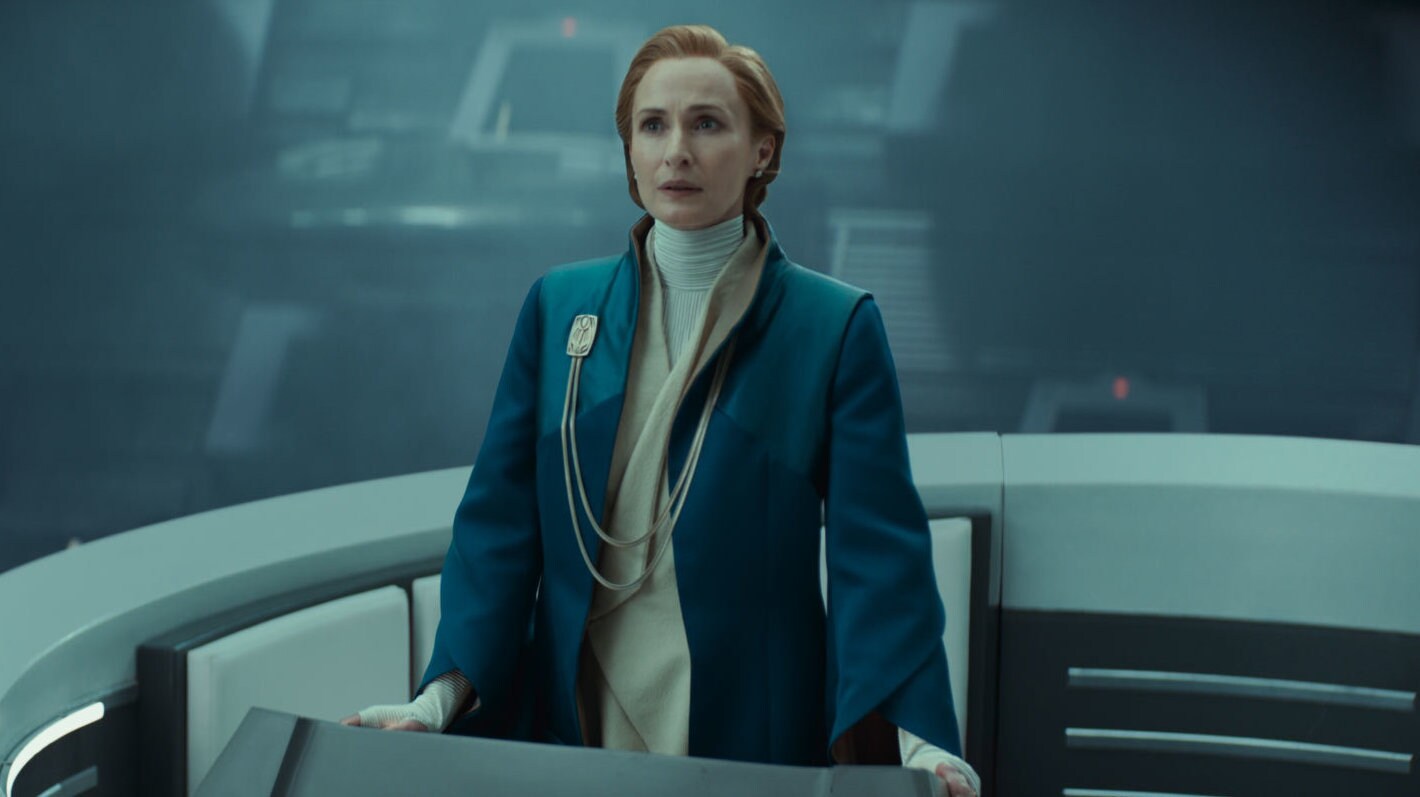

Andor has earned a lot of praise since premiering in 2022, including standout moments in both seasons that have redefined what Star Wars is capable of. But season 2’s third story arc — “Messenger,” “Who Are You?” and “Welcome to the Rebellion” — blows the rest of the show out of the water. In these jaw-dropping, pulse-pounding, mind-blowing episodes, Mon Mothma, Bix Caleen, Syril Karn, and the people of Ghorman reach their breaking points over the course of a few momentous days that see tyranny at its worst and resistance at its finest. The result is, quite simply, the best Star Wars content that has ever been made.
Wrestling with destiny
Over the past six episodes, we’ve watched Cassian mature as a rebel, deepening his skills in the service of the cause. But as some of his biggest challenges approach, Cassian isn’t even sure if he wants to remain a rebel. Throughout this story arc, he vacillates between serving the Rebellion and flirting with leaving it. The result is a kind of “will he stay or will he go?” whiplash that is only resolved when someone else takes the decision out of Cassian’s hands.
Cassian’s conversation with Kleya in episode 9 — remarkably, the first time these two have spoken on screen — captures his dilemma. After everything he’s seen and done, he’s tired of rebel life and wants out. He wants to savor the kind of peace and companionship that has eluded him since Ferrix. But as Kleya reminds him, the very hardships he’s endured have also lit a fire in him that won’t be easy to suppress. “You were a witness to the Ghorman Massacre,” she says. “One would think there’d be no stopping you.” But for Cassian, staying or leaving isn’t just about whether he wants to hurt the Empire. It’s also about whether he’s fighting on his own terms. “I need to start making my own decisions,” he tells Kleya. In response, she tries again to appeal to his sense of justice: “I thought that’s what we were fighting for.” Cassian wants freedom; Kleya understands that. But as she reminds him, their fight is about guaranteeing everyone the freedom he’s aching to savor. If he walks away now, he’ll be renouncing the chance to bring that liberty to others. Is he really comfortable doing that? This point seems to resonate with Cassian, but as he processes her words, it’s unclear if they will be enough to convince him to stick around.
Just as we start to see Cassian yearn to leave the Rebellion behind, a chance encounter forces him to confront the unpleasant possibility of a different fate. With Cassian’s shoulder still hurting from a recent injury, Bix brings him to a Force healer tending to her fellow rebels at the Yavin 4 base. Cassian, an eminently practical man, scoffs at the idea of Force healers. Bix insists that people wouldn’t fake something that had never worked, but Cassian can’t understand that logic, because in his experience, people are capable of all kinds of deception. Again, the two are at loggerheads. Bix says that if she were in pain, she’d do everything possible to heal herself. (We saw her do just that in the previous story arc by killing Gorst.) She can’t fathom why Cassian just carries on pretending everything is fine, even if everyone around him knows it’s not. Here we see another reminder of Cassian’s stubborn stoicism: He’s so focused on his mission that he doesn’t think he should spend time trying to heal himself. (This surely feeds into his discontentment with rebel service. It’s easy to imagine him reflecting on his selflessness in quiet moments and wishing that he didn’t have to prioritize others this way.)
But something unexpected happens when the Force healer lays her hand on Cassian. After a few seconds, she thanks him for showing her a clarity that she hasn’t encountered in a long time. Unlike others who carry the past inside them, she tells Bix, Cassian is gathering strength for a specific purpose. “There’s some place he needs to be.” This mystical certainty is anathema to Cassian. Like many heroes, he rejects the sense of destiny that the Force healer presents him with. We see this again later when Luthen reminds Cassian about their first meeting, saying their partnership ensured that the Empire would eventually hang both of them. Luthen’s allusion to a fate sealed years ago — a destiny — clearly bothers Cassian, who tells Luthen, “I make my own decisions.”
But as Bix intuits after Cassian storms away from the Force healer, he’s not just dismissive of the idea that he has a destiny. He’s scared of it. Part of him understands, in some inexplicable way, that the healer is right — that he does have a strong sense of purpose and that it is leading him somewhere. “Maybe you’re the place he needs to be,” the healer tells Bix. As we’ll see later, Bix eventually determines that this isn’t true. The Rebellion is where Cassian belongs.
Back at their quarters, Cassian rejects the idea that the Force healer was real, dismissing her as just a cook. Bix responds by pointing out that Cassian himself is “more than a pilot.” In other words, people have jobs, but they also have a presence in the world around them that can surpass those jobs. Bix isn’t afraid to admit that she sensed something pass between Cassian and the Force healer — unlike Cassian, she’s open to the idea of ethereal forces shaping the world around them. And she reveals that she’s had dreams about Cassian being a messenger. But this is too much for Cassian. He again instinctively rejects the idea that he has a destiny and gets mad at Bix for playing into it. I love seeing this fracture in their rapport. Pushing on the tension between their views of Cassian’s future — one idealistically grand, one determinedly trivial — is the perfect way to keep their relationship interesting.
Still, I don’t know how I feel about the idea that the characters in Cassian’s life can somehow sense that he has a destiny. It makes the story feel too much like a Campbellian hero’s journey, rather than a chronicle of an ordinary person who responds to extraordinary circumstances. I’m fine with powerful Jedi like Luke being immersed in warnings about their destiny, but with Cassian, it just feels too mystical.
As Cassian wrestles with his future, he also struggles to adapt to life on Yavin, where a loose network of like-minded fighters is gradually becoming an army, with all of the rules and formality that that term implies. Part of Cassian sees the value in a place like Yavin — he and Bix recognize the need for discipline, which is part of why they’ve grown estranged from Luthen, who is deeply uncomfortable with Yavin’s openness and unpredictability, and Wilmon, who has been flouting Yavin’s rules by doing side missions for Luthen. Wilmon, hotheaded as always, favors Luthen because he acts, but Cassian and Bix take the longer view. Cassian’s question to Wilmon about whether he wants to fight or win is astute — operating solo or as part of a small cell might feel vindicating in the short term, but it won’t win the war in the long term.
But even though Cassian tells Wilmon to follow Yavin’s protocols, part of him also bristles at these strictures. “The day I need permission to come and go,” he tells Draven, “I’m gone.” Despite committing to the cause, Cassian hasn’t yet committed to this particular group. He still values his independence in a movement that is rapidly developing a hierarchy and rules. It’s another trait that he’ll have to grow out of before he can become the devoted spy that we meet in Rogue One.
The mission to assassinate Dedra Meero illustrates Cassian’s uncertainty about where he stands. Despite the wisdom of going after Dedra, Cassian is initially loyal to the Yavin command structure and rebukes Wilmon for continuing to bypass it. Based on how Cassian feels about Luthen’s side missions interfering with the work on Yavin, it doesn’t seem like he’s going to take the Dedra assignment. But then later, he does take the mission. It’s hard for me to understand what happened there, except as a reflection of Cassian’s independence and unpredictability. (Perhaps he did it as a favor to Bix.)
With Cassian on the fence about his future in the Rebellion, a conversation between Bix and Vel provides further evidence of his importance to the movement, reinforcing the idea that he does indeed have a destiny. Vel tells Bix that the Yavin leadership wants to promote Cassian but is alienated by his disobedience. “We’re not Luthen’s puppets anymore,” she tells Bix, in a great moment that really drives home how far Vel and the others have come since Aldhani. They’re part of a sophisticated and organized operation now, and as Vel sees it, they have to act like it. “We’ve all given so much,” she says. “A little discipline doesn’t seem too much to ask.” She’s right, but Cassian isn’t yet ready to acknowledge this. He still values his independence too much. Recognizing the need for discipline will take maturity that he has yet to acquire. Bix surely recognizes this, but her faith in Cassian compels her to defend him anyway. “He’ll be there when you need him,” she tells Vel, and as we know, Cassian will eventually prove her right.
Subjugation preparations
As Cassian ponders his future, the situation on Ghorman is rapidly nearing its endgame, one that will make the mayhem on Ferrix look like a tea party in comparison.
When we reconnect with the Ghormans in episode 7, it’s clear that a year’s worth of Imperial oppression has taken its toll. Carro Rylanz has renounced violent insurgency in favor of peaceful protest, evidently convinced that vigorous resistance has only made things worse for his people. But the Empire’s tightening noose has only further radicalized Rylanz’s younger compatriots, who mock his insistence on dignified defiance. “We left dignity behind years ago,” one operative tells Rylanz. Another partisan says that they all know what’s coming and that it would be absurd to just lie down in the face of it. The young fighters’ bellicosity is completely understandable, but it’s also tragic, because as Rylanz correctly intuits, the Empire’s goal is to bait them, and it will prove foolish to play into its hand.
Back on Coruscant, the anti-Ghorman sentiment in the air is practically electric, and the planet’s senator, Dasi Oran, is despondent. With his planet “near the point of no return,” as he tells Mon during their deeply sad conversation, he can sense that the writing is on the wall for him. He may be keeping his head down, but his position and allegiance still make him a threat to the Empire, and he knows it’s only a matter of time before he’s arrested. Oran’s every word in this scene conveys profound sadness. His line, “They don’t even bother to lie badly anymore. I suppose that’s the final humiliation,” is particularly brutal. The Empire is so confident of victory on Ghorman that it doesn’t even need to be subtle or plausible with its false-flag operations. It knows that the people of the galaxy aren’t in any state to see reason; they’ve been fed too much propaganda to question what they see on the news. By not trying to be subtle, the Empire is further wounding the Ghormans by reminding them that it can get away with anything and no one is coming to help them.
As Oran thanks Mon for everything she’s done for Ghorman, you can tell that she understands that this will likely be the last time they speak. They’re in public, so she has to keep herself together, but the emotional weight of the moment is almost too much for her. As she and Oran part ways, her face conveys her deep heartbreak, as well as her intense fear about what comes next.
While Mon and Oran wait for the other shoe to drop, the Empire completes its final preparations. A conversation between Partagaz and Dedra reveals that the Emperor himself has taken a personal interest in the situation on Ghorman, a sign of just how important the planet’s unique mineral, kalkite, is to his secret plans. And to give the Emperor what he wants, the Imperial Security Bureau and the Ministry of Enlightenment have spent the past year conducting a two-part operation to bring Ghorman to its knees.
The first part of the operation becomes clear when Cassia, Bix, and Wilmon first discuss Ghorman. Cassian assumes that Luthen is the one destroying Ghorman, but Wilmon corrects him. There’s no longer that much genuine rebel activity, he says; the Empire is now ruining things all by itself. To justify the imposition of a security state that will be crucial to the Empire’s next move, the ISB has spent the past year peppering Ghorman with staged terrorist attacks. The result is an oppressive lockdown in the capital city of Palmo, with a curfew, ID checks, and frequent alarms and warning announcements.
But it’s the second part of the operation that truly highlights the Empire’s depravity. To turn the galaxy against the supposedly insurrectionary Ghormans, the Ministry of Enlightenment feeds outraged talking points to the loyal pro-Imperial media, which spouts them in a series of news reports that punctuate these three episodes. (Seconds after Partagaz mentions continued and inexplicable resistance to Imperial norms and the Empire’s long-suffering patience, a reporter recites the same line almost word for word, bitterly underscoring how manufactured the whole situation is and how important a role the media played in manufacturing it.) The resulting broadcasts poison people’s minds against Ghorman and further expand the permission structure for Imperial repression. I’ve always wanted to see how the Empire uses journalists to soften the ground for its policies, so I was thrilled to see Andor shine a spotlight on the media like this.
The pro-Empire reporters are so excellently vile as they confidently lie to the galaxy about baffling Ghorman hostility to Imperial rule. Part of why these odious reporters are so compelling, of course, is because their slick but acrimonious personas mirror those of many real-life cable-news personalities. I especially love how the montage of pro-Empire news reporting on the supposed terrorist attacks plays as we enter the Senate building in episode 7. It really helps sell the feeling that this barrage of propaganda is seeping into the operations of the Senate and hovering in the background of everything senators do. I also appreciated how one scene cut from a journalist’s report from Ghorman to a transfixed Eedy watching that report on Coruscant, emphasizing how the accounts that we know to be distortions are being received as truth back in the center of power.
If the Imperial propaganda is meant to encourage people to dehumanize the Ghormans, several of the Imperials we see in this story arc are already chillingly eager to engage in that same dehumanization. You can see it in Partagaz’s sterile language, referring to the false-flag expert Captain Kaido as a “crisis specialist” (one who specializes not in solving crises, but in creating them) and tossing off phrases like “fiddling with the calendar” to describe planning for a genocide. Moments like these emphasize the bureaucratic nature of the brutality we’re about to see. To the Empire, their victims aren’t people with dignity, just statistics to be project-managed.
Kaido, too, evinces this dehumanizing attitude. When Dedra asks him if the Ghorman protest is unfolding the way he wanted, he replies, “What I want is a comfortable ride home.” Kaido is about to preside over a war crime, but the cruelty he’s imposing on Ghorman doesn’t even register to him. He sees the whole brutal operation through a frighteningly dispassionate lens. You get the unnerving sense that he does large-scale, horrible things like this all the time. Later, after the shooting starts, Kaido smiles at the mayhem in the plaza before turning and casually striding out of the room. His work is done, and the evil of it doesn’t phase him for a second. It’s just another day on the job for this monster. Kaido is one of the most soulless characters in the entire show, and it’s impressive how much development he gets in just a few short scenes.
Carefully crafted chaos
It’s finally time to discuss the Ghorman Massacre. Episode 8’s astonishingly powerful depiction of the Empire’s sickeningly devious plan is one of this story arc’s signal triumphs and one of the most incredible things I’ve ever seen on television. With exquisite finesse, Andor builds suspense, moves everyone into position, and springs the trap.
As tensions on Ghorman continue to rise, the Empire starts a rumor that it’s opening up Palmo’s central plaza. This convinces the Ghormans, bursting with pent-up frustration, to seize the opportunity to protest while they can. But it’s a trap. Because of his hotel room’s vantage point, Cassian can see the Empire setting up barricades in the plaza, whereas the Ghormans — who aren’t allowed nearby — are unaware of the restrictions awaiting them. It’s a really smart play by the Empire, exploiting the anger and exasperation that they know the Ghormans are feeling. And even as the Ghormans spontaneously mobilize, the Empire has already crafted a lie about them launching a planned general strike. The smoothness of the propaganda is chillingly impressive.
As the protesters march toward the plaza, Carro Rylanz, who has become the lone voice of sanity, urges his daughter Enza not to join the demonstration, saying that the crowd’s unruliness will only make things worse for Ghorman. But Enza is done listening to her overly cautious father. She sees an opportunity to make her voice heard, and she thinks it would be cowardly to reject it. Later, Carro tries to convince other protesters to turn back, but it’s too late. No one wants to be talked down. Carro’s futile efforts are profoundly sad. He alone can see what the Empire is doing, but the sea of humanity swarming past him is a testament to the fact that his people are done being careful. The Empire is counting on their impatience and defiance to doom them.
As they march, the protesters shout, “We are the Ghor! The galaxy is watching!” It’s a bleak moment, because they’re wrong. Sadly, no one will be watching what happens in the plaza. The Ghormans are too naive to realize that they’re being led into a trap from which only the Empire’s description of events will escape.
The leadup to the demonstration perfectly captures the mounting turbulence and unease in Palmo. The scene cuts between the raucous protest march, with demonstrators blaring horns and shouting for others to join them, and the quiet plaza, which is empty save for soldiers moving barricades into position. Every time you see the still-peaceful plaza, you feel an alarming sense of an inescapable storm approaching. Then, as the Ghormans assemble in the plaza, the tumultuous mix of smoke, horns, shouts, and bodies perfectly conveys the growing tension. The way the Ghorman Front operatives reunite with each amid a sea of energetic chanting really drives how chaotic but also exciting the protest has become, as if the very fact of everyone coming together has created a glimmer of hope. Throughout it all, the music does a great job of accentuating the mounting unease. That scene had me on the edge of my seat in a way that I haven’t been in a long time.
The first sign that things are about to go horribly wrong is the arrival of stormtroopers on the steps surrounding the plaza. Andor rarely uses stormtroopers, preferring to assign its grunt work to regular Army and Navy soldiers. So when these iconic symbols of Imperial oppression arrive, it’s an ominous sign whose weight we feel acutely. The cutaway shots of stormtroopers standing motionless on the steps give the troopers an air of menace and lethality that Star Wars has never been able to give them before. For the first time, these rigid, skull-faced soldiers genuinely scared me. Andor’s ability to do this is one of its most impressive accomplishments.
With the mood in the plaza suitably tense, Captain Kaido orders the sergeant in charge of the newly arrived squad of young, inexperienced soldiers to march them out into the crowd. The sergeant can tell that this is a recipe for disaster, but ultimately, he has no choice but to follow orders. His misgivings are more accurate than he could possibly know.
The vast majority of the protesters flocked to the plaza to peacefully object to Imperial occupation, but the Ghorman Front knew that the massive gathering could serve their interests too. Things escalate quickly in an unruly crowd, especially violence, and the insurgents knew that they could use this to their advantage. Unfortunately, the Empire knew this too, and it was counting on the insurgents to do exactly what they did.
When Lezine begins singing a Ghor song, a man standing near him gives him a puzzled look. But as the other Ghorman Front operatives join in from their positions around the plaza, the crowd’s chanting slowly gives way to their song. Soon, everyone is singing the popular tune, expressing a more pointed, if more melodious, opposition to Imperial rule.
Andor does a truly magnificent job of slowly turning up the pressure in the plaza. First, the crowd switches from the chant to the song. Then the soldiers start their patrol. Then someone throws a projectile at the soldiers. Then people start throwing more projectiles and jostling the soldiers. The escalation is punctuated by swells of dystopian music and almost haunting cutaways to the stormtroopers standing watch. We’re seconds away from disaster.
It’s not initially obvious why the Empire has brought inexperienced young soldiers to Ghorman, but the events on the plaza make things horrifyingly clear. I love how the show slowly but inexorably reveals the soldiers’ purpose as hapless bait for an angry crowd — and sacrificial lambs for a false-flag attack. As you watch them nervously wade into the mayhem, you feel a dawning sense of dread as you realize what’s about to happen to them and how it’s going to be weaponized against the Ghormans.
After a conversation from Partagaz that leaves Dedra looking shaken, she begrudgingly orders Kaido to proceed with his false-flag instigation. As Kaido relays the order to his sniper, Dedra appears distraught. Is she worried about Syril down in the crowd, or is she having second thoughts about the whole operation? I can’t imagine what it must feel like to metaphorically pull that trigger — especially if you’re suddenly convinced that it’s a despicably evil thing to do.
With the Imperial sniper’s first shot (which kills a frighteningly young-looking soldier), the escalation is complete, and the Empire converts the protest into a massacre. The next five minutes are full of some of the most disturbing shots ever seen in a Star Wars production, as panicked soldiers shoot protesters dead at point-blank range, stormtroopers fire on the crowd from a distance, and Kaido’s sniper picks people off while they flee. Several moments stand out from this slaughter: a civilian cut down as she tries to run past Cassian; the hotel clerk urging people to flee so he can set off a grenade that destabilizes the Imperial response; the Ghorman Front member Dilan taking a shot to the gut that will later kill him; and a KX droid kicking a barricade with such force that its impact hurls a Ghorman into the air.
Speaking of the KX droids, Andor does a great job of making them truly terrifying. In addition to the barricade-kicking moment, we see the droids kill multiple people by nonchalantly hurling them into walls. There’s also a deeply disturbing shot of Enza desperately crawling away from an implacably approaching droid, which then mercilessly hurls her through the air — as Dilan screams shrilly — until she lands with lethal force (and a brutal thudding sound), her body rolling to a stop to reveal her lifeless face. That is one of the most horrible things I’ve ever seen.
As the carnage continues, Ghorman Front operative Dreena races back to the group’s hideout and tries to alert the galaxy to what’s happening. “They made this fire and led us to the slaughter,” she says plaintively. “Now they expect us to die without knowing why.” Her desperate broadcast is one of the most heartbreaking scenes in all of Star Wars, her hauntingly eloquent words perfectly conveying the Ghormans’ anger, terror, and misery as they beg for attention from an unhearing galaxy. “Is there no one who can help us?” she shouts into the void. Her speech pairs beautifully with the dismal montage of a wounded Ghorman, from a dead Dilan to a shell-shocked Rylanz. Even Cassian cries as he races away from the plaza in a stolen vehicle. We get the sense that the massacre has shaken him to his core.
The Ghorman Massacre has barely ended before a media commentator solemnly intones that the “insurrection” will increase “the price we’ll pay for our own safety.” It’s a chilling sentiment that reminds viewers of an important but heretofore overlooked fact: The massacre wasn’t just a resource grab; it was also a way for the Empire to reinforce its draconian grip on the galaxy by scaring its citizens into accepting more surveillance, more oppression, and more of the injustices that will eventually kindle the fires of rebellion.
Untimely epiphanies
In addition to ripping apart Ghorman society, the massacre also rips apart Andor’s weirdest relationship, Dedra Meero and Syril Karn, and leads both of them down completely unexpected paths.
From the moment Partagaz tells Dedra that the Empire is proceeding with its original plan of stoking a fake Ghorman uprising, it’s clear that Dedra doesn’t like this idea. In episode 7, she heatedly asks Partagaz for more guidance on how to handle the situation, only to be rebuked, told to calm down, and reminded that she’s about to ascend the ranks. Everyone who matters knows Dedra’s name and how well she’s done, Partagaz tells her, clearly trying to bypass her resistance by dangling the prospect of glory in front of her.
But no matter how much glory awaits Dedra, things on Ghorman only get worse for her. In episode 7, Partagaz effectively subordinates her to Captain Kaido, whose deployment of undisciplined grunts clearly disgusts Dedra. Then in episode 8, she’s caught off guard by the Empire’s prepositioning of mining equipment and stunned by Partagaz’s dismissal of her concerns. Her lack of control over Kaido (“I’m the trigger, Supervisor. You’re the finger. Make sure you’re available.”) clearly adds to her growing feelings of unease and helplessness. Later, as the massacre ends, Dedra suffers a full-blown panic attack, clawing at her collar for air and tugging vigorously at her tunic as if seeking comfort in a familiar habit.
Dedra’s revulsion to the Ghorman Massacre was the weakest part of this story arc. She’s known the Empire’s end goal this whole time; how could she, with all of her ruthless experience, not have predicted what the Empire would do to pacify Ghorman? And why would someone so resolutely cold-hearted object to the Empire’s plan? I guess you could argue that she thought the Empire just wanted to use a (mostly fake) insurgency as cover for instituting martial law and displacing the Ghormans before beginning mineral extraction. But are we really supposed to believe that this woman — who didn’t bat an eye at Doctor Gorst’s use of a torture device created from the extermination of a sentient species — drew the line at mass murder? I’ve really enjoyed Dedra’s storyline in Andor, because she wasn’t like other Imperial officers, but this was a very disappointing turn for her character.
Syril, on the other hand, underwent a fantastic transformation in the chaos of the Ghorman Massacre. His loyalty to the Empire was always more innocent and reasonable than Dedra’s, and it makes perfect sense that what he sees on Ghorman tests (and then exceeds) the limits of his faith in Imperial justice.
From the very first conversation that Syril and Dedra have in episode 7 about the accelerating turmoil on Ghorman, it’s clear that Syril is skeptical of the official story. He’s heard rumors from his own sources that the Naval Depot bombing was a false-flag attack. Dedra gives him the runaround, unable to reveal that his sources are correct. But Syril is growing tired of the unexplained activity, the new personnel, the feeling of being in the dark, and the need to beg for evidence. He wants to know more about what’s really going on, believing that his service to the Empire has earned him a place in the room.
Dedra’s subsequent lie — that the Empire believes outside agitators are causing the trouble on Ghorman — gives Syril an explanation for the Empire’s acute concern without revealing the real plan to blame and subjugate the mostly innocent civilian population, with which Syril has come to sympathize. But, importantly, this explanation also confuses Syril. He thought his job was to attract outside agitators and stamp them out in order to protect people like the Ghormans, and now he sees the Empire cracking down on the entire Ghorman population in response to this phantom threat. The broad nature of the Imperial response doesn’t make sense to him.
Frustrated, Syril tells Dedra that his sources say the outside-agitator claims are “nonsense.” Dedra, aware that he’s prying too deeply, worries for his safety. She urges him to back off and get ready to leave Ghorman. She says they’ll be rewarded, but Syril, who thought their job was to attract agitators who he knows aren’t really there, doesn’t understand what they’ve actually accomplished.
Syril’s street confrontation with Enza was the moment when I first realized his true feelings about Ghorman. With the Empire convinced that the Ghorman Front is being manipulated by outside agitators, Syril wants Enza’s help blaming outsiders for the group’s activities as a way of protecting them. It turns out that Syril actually believes what he told Eedy in episode 4 about the Ghormans being peaceful and innocent. He thought he was investigating the Ghorman Front in order to weed out destabilizing insurgents and make the planet safer for civilians. He genuinely doesn’t understand why the Empire is punishing the Ghormans, and he’s looking for any way to shift the blame off of them and protect them. I can’t tell if he knows there are no outside agitators or if he thinks that there might be, but either way, he wants to use that notion to shield the Ghormans from punishment. It’s really fun watching Andor upend our assumptions like this.
Knowing how Syril really feels about the Ghormans makes his later encounter with Carro Rylanz more tragic. I believe him when he tells Rylanz that he meant the Ghormans no harm. I think he genuinely believed that he was on Ghorman to “trap outside agitators,” not to murder the Ghormans themselves. But Rylanz is too forlorn to believe Syril. “What kind of a being are you?” he asks Syril. You can really feel his horrified awe as he confronts someone who he thinks has been callously manipulating him for a year. His demands for answers (“What’s in our ground?!”) show his agonized confusion about the Imperial occupation and his misery about being a helpless bystander to the Empire’s clever domination of his people. For Syril, the distraught Rylanz is the living embodiment of his mistakes — walking evidence of Imperial duplicity and barbarism that is, at last, too obvious to ignore.
Minutes later, Syril encounters more evidence. As he approaches the Imperial office complex, he watches a pro-Empire journalist spouts laughable lies about the growing protest, saying that the Empire tried to negotiate for a peaceful demonstration, that “local insurgents” spread incendiary rumors, and that the angry but civilized protest is actually a “highly volatile insurrection.” A realization is dawning on Syril: He’s part of something thoroughly evil.
By the time he reaches Dedra’s office, Syril is coming unhinged. When Dedra tries to duck his questions about the plan for Ghorman, he becomes violent, grabbing her, choking her, and threatening to throw her out of a window if she doesn’t tell him the truth. I was genuinely stunned to see Syril snap like this, and Dedra was clearly surprised too; neither of us thought he had it in him. But seeing the undeniable evidence of the Empire’s lies shattered his trust in the system that defined his life, and in that disoriented state, people do all kinds of unexpected things.
When Dedra explains that the Empire staged the massacre in order to seize Ghorman’s kalkite, Syril’s world falls apart. He genuinely believed in the promise of Imperial order and wanted to stop insurgents so he could make the galaxy a safer place; carefully planned mass murder is beyond the pale to him. Stories often stumble when they try to “redeem” villains, but Andor skillfully avoids those mistakes with Syril. It makes perfect sense that someone with his ideals would be repulsed by the discovery of what the Empire was really doing.
After Syril flees the Imperial office complex, a long, slow circling shot shows him taking in the massacre with a dazed expression. It’s worth considering how quickly things have escalated for him — a few hours earlier, he thought he was just hunting outside agitators to protect the people of Ghorman, and now he’s standing in the middle of a full-on war crime against those people. Kyle Soller’s face acting is exquisite as he portrays a man overwhelmed by moral disorientation.
That might have been the end of Syril’s journey — an Imperial who saw the error of his ways and fled into obscurity. But as Syril scans the chaos in the plaza, he sees a familiar face: Cassian. I love this moment — you can see Syril sputter with disbelief as he realizes that a piece of his past has reemerged. It’s no surprise that he immediately makes a beeline for Cassian. Everything he thought he knew about his work on Ghorman turned out to be a horrible lie, but hunting Cassian was right and just, and maybe now he can finish that mission. On a simpler level, Cassian is also just an easy target for Syril’s rage. Syril can’t prevent the slaughter unfolding around him, and he can’t undo how Dedra and the Empire used him to stage a massacre, but he can take out his fury on Cassian, the man who put him on this awful path years ago. Syril might actually have forgotten about Cassian over the years, but you can tell that seeing him again brings it all back.
Syril and Cassian’s fistfight is brutal, like nothing we’re used to seeing in Star Wars, and I love how we see brief snippets of the broader chaos in the background of their brawl. But the most dramatic moment of the fight isn’t one of the punches or slams; it’s Cassian asking Syril, “Who are you?” For all of Syril’s character-defining obsession with Cassian, Cassian barely registered Syril’s existence. They met once, briefly, on Ferrix, but it meant so little to Cassian that he forgot all about it. This fact makes Syril’s ultimate fate even sadder. He probably could have escaped Ghorman with his life (and his newfound understanding of the Empire’s barbarity) if he had just resisted the urge to settle a grudge, but instead, he threw away his future for revenge, and, in one of this story arc’s biggest surprises, he died fighting someone who didn’t even remember him.
As episode 8 ends, we see Eedy weeping as she watches an Imperial news report about the Ghorman terrorist attack, giving us one last glimpse of the life that Syril left behind and the last strand of his humanity.
The truth will set you free
The Ghorman Massacre was one of the most well-constructed and emotionally effective storylines in all of Star Wars, but when it comes to this story arc’s crowning achievement, even Ghorman has to take second place to the harrowing final days of Mon Mothma’s time in the Imperial Senate.
As Senator Oran predicted, the Empire is using the excuse of the Ghorman “terrorist attack” to arrest and, most likely, quietly execute him. As stormtroopers lead him away, he warns his colleagues that their decision to condemn the Ghormans to death by turning a blind eye to their suffering is a short-sighted mistake that they will someday come to rue. “It’s my people today and yours tomorrow!” he shouts. This warning — which resonates profoundly in the real world — also proves prescient about one of the people who hears it: Bail Organa, whose own planet will soon suffer an even worse fate.
As Oran is led away, Mon tells Bail that it’s time for them to take off their masks, denounce the Emperor, and go into hiding. She clearly can’t imagine sticking around any longer; she’s exhausted from spending so much time pretending to be part of a machine while secretly working to undermine it. “Nothing we will ever do will be as hard as hiding all these years,” she says. We see another sign of Mon’s exhaustion later, when Erskin carefully places the ISB listening device on her desk — clearly not wanting to tip off the ISB to its discovery — and Mon unceremoniously smashes it with a paperweight. She’s done masking her true intentions, and while going public undoubtedly scares her, it also probably feels like a relief.
Bail, however, refuses to leave. He believes that he can still do more good in the Senate, wielding arcane procedural rules to stymy the Empire while buying time for the operation on Yavin to mature. I admire him for taking this risk — particularly after Mon’s escape, his situation will become much more perilous.
As Mon practices her fateful speech, she receives an unexpected visitor: Luthen Rael, who’s come to warn her about a flaw in her escape plan. How did he know where she was? He’s co-opted her trusted aide Erskin. I love this revelation — spying on an ally is the perfect demonstration of Luthen’s paranoia. But leading off with that admission creates an uphill battle for Luthen as he tries to convince her to escape with his agent instead of Bail’s team.
Luthen’s insistence that Mon trust him reminds her of Tay Kolma, whom Luthen had killed to eliminate a risk. The specter of her possible capture makes her wonder if Luthen would do the same to her if it was necessary to protect himself. “Right now,” she tells him, “I’m more afraid of you than anything.” (Given what she’s up against, that’s a remarkable statement.) This distrust makes for excellent drama. Obviously, Luthen wants to keep Mon safe, but given what he’s done to protect himself, we can’t know for sure what he’d do if Mon were captured, so it’s completely reasonable for Mon not to trust him. This is really rich, nuanced storytelling — it’s much more interesting for two people on the same side to distrust each other (for valid reasons) than it is for them to be best friends who trust each other implicitly. Just because they share the same goal doesn’t mean there aren’t reasons for them to worry about each other.
I also love the fact that Bail Organa’s rescue team has been infiltrated by the ISB. Mon obviously trusts Bail, but the fact that she can’t rely on his help in her most perilous moment (or warn him about his ISB mole) is a brutal twist that adds an element of tension to their alliance. I didn’t catch this at first, but the show subtly hints at how Luthen knew that Bail’s team was compromised: The ISB agent among them was reporting to Lonni Jung, who was working for Luthen. The amount of narrative depth in this show is incredible.
After receiving Luthen’s warning, Mon returns to her office, where a subdued Erskin is waiting. Mon tells him that she can’t remember a worse betrayal, “and I’ve had some experience.” I can’t imagine what it must feel like to learn that the one person you thought you could trust and confide in has been spying on you. Mon already felt deeply isolated and lonely, and now, just as she’s about to take the biggest risk of her life, she’s truly alone.
As the Senate prepares to convene, Mon has one last conversation with Bail. “You don’t have to do this,” he tells her. “If you’re brave enough to stay,” she responds, “I should be brave enough to go.” It’s a touching moment, but we know that Mon is holding something back. She might be mad at Luthen, but she’s decided to trust his warning about Bail’s team. Her friend’s staff is compromised, which means so is his safety, but she can’t alert him without jeopardizing Luthen’s operation.
Before they part ways, Bail tells Mon, “Tear the shit out of this place.” This is a phenomenal line; it’s one of my favorites of the entire story arc. You really get a sense of how much Bail and Mon loathe what the Senate has become over the past 20 years. With Mon’s planned speech, one of them finally has a chance to publicly express their disgust and take the Senate to task for its dereliction of duty.
But first, Mon has to be recognized to speak, and with the Senate’s leadership in the Emperor’s pocket, that won’t be easy. Enter Bail, the consummate political strategist and master of Senate procedure. In a moment worthy of The West Wing at its best, Bail cleverly forces Mon’s recognition through a kind of political shell game. After arranging for the senior senator from Hodi to yield the floor to him, Bail invokes a Senate rule (proposed by the Emperor’s Council, no less) that lets him yield to another senator without interruption in the case of an emergency. With a straight face and delightful disingenuousness, Bail cites his pro-Empire colleagues’ references to the Ghorman situation as an “emergency” to justify invoking this rule. I absolutely adored this scene — Bail’s ruse is a brilliant sleight of hand that adds an amazing dose of political drama to Star Wars. I love seeing the few remaining proponents of democracy in the Senate outmaneuver and exploit the rules to accomplish their goals. Heck, I would watch an entire series with this premise. (Yes, I’m totally normal, why do you ask?)
At last, we arrive at Mon’s speech. In-universe, it’s the most important one of her career; in the real world, it’s one that fans have been breathlessly awaiting ever since we learned that this season would feature the Ghorman Massacre. In both cases, the stakes are incredibly high. And boy, does Andor deliver the goods.
Mon’s speech is utterly amazing. In a few short sentences that rank among the best writing in the history of Star Wars, she condemns the dishonesty and brutality of fascism in urgent, unequivocal terms, energizing the show to a breathtaking degree and further cementing her legacy as one of the most impressive characters in the entire franchise. “What happened yesterday on Ghorman was unprovoked genocide!” she thunders, drawing out the provocative accusation. As befits Andor’s political consciousness, most of the other lines in her speech double as warnings to the viewer. “Of all the things at risk, the loss of an objective reality is perhaps the most dangerous,” she says. “The death of truth is the ultimate victory of evil. When truth leaves us, when we let it slip away, when it is ripped from our hands, we become vulnerable to the appetite of whatever monster screams the loudest.”
With the Senate chamber in an uproar, Mon drops the mic: “The monster screaming the loudest? The monster we’ve helped create? The monster who will come for us all soon enough … is Emperor Palpatine!”
If you didn’t get goosebumps watching this speech, go see a dermatologist.
I mean, my god.
In many ways, the show’s depiction of Mon’s speech mirrors its depiction of Maarva’s speech at the end of season 1: An influential person reflects on her legacy, while the Empire tries and initially fails to interfere with her denunciation of it and Cassian positions himself for a rescue mission. Twice now, Andor has gotten great mileage out of a dramatic speech playing in the background of a montage of urgent activity. (Three times, I guess, if you count Dreena’s speech at the end of episode 8.) In this case, the urgent activity is the ISB frantically trying to silence Mon as she unloads on the Empire for its barbarity on Ghorman. The head of the Senate media service tries to shut off the broadcast feed, only to discover that the system’s controls are locked. As he panics, two of his employees proudly inform him that they just “fixed” the system by locking it down according to protocol. As he storms away, they share a moment of satisfaction; as Nemik wrote in his manifesto, “Even the smallest act of insurrection pushes our lines forward.”
As soon as she steps out of the Senate chamber, Mon is a hunted woman. Fortunately, her rescuer is waiting right outside the door for her. Andor is named after Cassian, but in many ways, Mon is its breakout character, so it’s wonderful to see the two of them finally meet and team up. When Cassian approaches her, Mon is so rattled that she initially forgets Luthen’s instructions about how to identify his agent. Only when Cassian volunteers his response phrase does she remember the plan. But even then, Mon is still paranoid that he’s faking his identity. By now, she truly doesn’t know who she can trust. But as Cassian points out, that also means that she’s out of options. At this point, she has to trust him. That’s what makes their escape so great: They’re not old friends with the benefit of years of trust; they’re new allies, one of whom is eyeing the other warily and worried that she’s in over her head.
When Mon says that she’s not sure she can keep it together long enough to escape, Cassian replies, “Welcome to the Rebellion.” By jumping into the unknown in the service of the cause, Mon is finally living the life of a true rebel. This kind of danger is new to her — her political work for the cause hasn’t exposed her to the kind of imminent peril that Cassian faces every day. They’ve both taken risks, but those risks have been very different. Now, Mon is getting a taste of the danger that rebels on the ground have faced for years.
One thing I hadn’t really considered about Mon until her extraction is that she’s not used to seeing violence and death up close. Each time Cassian kills someone during their escape, it shocks Mon to her core, sending her into a daze. “You killed that woman,” she tells Cassian weakly after Cassian guns down the ISB mole on Bail’s team, as if her brain can’t process what just happened. Cassian’s murder of her driver (and ISB minder) Kloris literally stops her in her tracks. These moments are valuable reminders of Mon’s privileged place in the Rebellion. She’s poured her heart into the cause, but she’s been able to do so from a safe vantage point, far from the oppression that she’s trying to stop and the violence that’s often necessary to stop it. But now she’s no longer insulated from the gritty reality of resistance, and her first exposure to death is so horrifying that it overwhelms her, rendering her immobile and forcing Cassian to steady her and guide her onward.
After a narrow escape from the Senate plaza, Cassian and Mon soar away to safety. I love the shot of Mon looking back at the Senate building as she flees. It’s impossible to know what she’s thinking, but I can imagine a few possibilities. Maybe she’s wondering if she’ll ever again see her workplace of several decades. Maybe she’s wondering what the people she left behind in that building think of her at that moment. No matter what’s on her mind, it’s a poignant moment. For decades, she’s defined herself by what she did in that place, and now she’s heading to a new place that will define her legacy.
After Cassian and Mon reach Luthen’s safe house, Mon has time to catch her breath while Cassian checks on Wilmon and talks to Kleya. There’s something incredibly moving about watching Mon stand by herself on the other side of the room while everyone else talks about her. You get this profound sense of her power, influence, and importance — she’s the center of attention, the hub around which all of the day’s events have revolved. But you also wonder how she’s processing everything, all alone by the window, staring out into a city whose streets she may never again be able to freely walk.
Mon is still overwhelmed as she talks to Cassian in the kitchen of his old home. In an uncharacteristically halting voice, she says that she doesn’t know how to thank him. He responds simply, “Make it worth it.” It’s a wonderful line that underscores the crushing weight on Mon’s shoulders. Leading the Rebellion obviously entails many responsibilities, but few are more important than making something meaningful out of people’s sacrifices — ensuring that they don’t suffer and die in vain. As the camera cuts to Mon, still overcome with adrenaline and emotion, we’re left to ponder how it must feel to know that that enormous responsibility rests with you.
When one door closes, another one opens
Despite everything Cassian has experienced on Ghorman and Coruscant, he returns to Yavin still intending to leave the Rebellion. When he and Bix reunite, he tells her that he’s done everything he can for the cause and he’s ready to move on. His latest brush with death has clearly reinforced his desire to live safely in hiding with Bix. He doesn’t want to waste any more of whatever time they have left together. Bix listens, not saying anything. Her expression is full of warmth and love for Cassian — she can tell how much he cares about her, and that makes her feel wonderful. But she also knows what she has to do. Despite what Cassian says, it’s not true that “the only special thing about [him] is luck.” He might believe, as he tells Bix, that nothing is worth more than their love, but by this point, she’s already become convinced that he’s wrong.
The next morning, Cassian wakes up to discover that Bix has left him. “I can’t be the reason you leave here,” she tells him in a recorded message. “We have to win. We have to beat them. And I believe you have purpose in making that happen.” Cassian won’t choose the Rebellion like he needs to, so she does the difficult thing and chooses it for him.
Ever since we first met Bix, I’ve been wondering how she would exit Cassian’s story, and I really like how it happened. Having her walk away is much more interesting and complicated than killing her off, and it’s almost as emotionally devastating for Cassian. Bix’s message is the perfect sendoff for her, a heartbreaking expression of both her love for him and her commitment to the greater good. While leaving him was one of the hardest things she’s ever done, her strong sense of justice wouldn’t let her do anything else.
Cassian doesn’t make it to the Yavin landing pad in time to stop Bix, but his arrival outside the hangar is serendipitously momentous. “They’re getting ready to power up the droid you brought in,” a soldier tells him. Still heartbroken over Bix’s departure, Cassian nonetheless gets back to work, monitoring the activation of the Rebellion’s new KX droid. After a technician delivers some expository dialogue about reprogramming the droid through “impulse suppression,” he flips a switch, and the robot bursts to life. With a conciliatory, slightly nervous greeting, the KX droid reveals itself to be free of its Imperial programming. Unbeknownst to anyone who witnesses it, this unassuming rebirth will launch a new era in the rebel journey of Cassian Andor.
Other thoughts about the characters
- Despite the tension in Cassian and Bix’s relationship, there’s still a hint of playfulness, as when Cassian and Bix joke about what she’s going to do to him when he’s shirtless.
- Wilmon accuses Cassian of seeing Luthen as the enemy now. Cassian says, “That would be easier” — meaning, he knows how to deal with his enemies, but he doesn’t quite know how to deal with Luthen at this point.
- I like that Vel is a member of the Yavin group. She seems like someone who would fit in well with their emphasis on discipline and maturity.
- Vel says she needed a break from smuggling runs because “I was getting reckless.” Her experience mirrors that of Cinta, who admitted to Vel during their last night together that she should have stopped taking Luthen’s more dangerous missions sooner. Vel clearly learned the lesson from Cinta’s struggle.
- Cassian’s reckless low-flying arrival on Ghorman is a reminder of both his skill as a pilot and his untamed, freewheeling spirit.
- I didn’t think we’d see the hotel bellman again, so it’s nice to see him now working the front desk. Cassian’s earlier kinship with him pays off as he warns Cassian about the hotel’s requirement to turn over visitor information. I like how he quietly reveals that he remembers Cassian, implying that he understands that Cassian is there undercover and is rooting for him. You can see him take a deep breath after Cassian leaves, almost as if he realizes that Cassian’s arrival means that things are about to escalate.
- The way Partagaz says, “It’s bad luck Ghorman,” almost makes it sound like he feels bad for the innocent people he’s about to kill. Almost.
- The way Dedra clumsily kisses Syril is another reminder of how bizarre their relationship was.
- Syril definitely seemed to be reconsidering killing Cassian before his own death. After he realized that Cassian didn’t know who he was, he started to lower his blaster. It’s almost as if, in the last few seconds of his life, he finally understood the pointlessness of his grudge.
- We as the audience know how important Mon is, but the characters aren’t always thinking about her in those terms, so it’s nice to hear Kleya explicitly say that, if Mon is arrested, “it all comes down.”
- I like how Erskin distracts the ISB agent long enough for Cassian to kill her. It’s great improvised teamwork, and it demonstrates Erskin’s unfailing loyalty to Mon.
- As stormtroopers swarm the Senate complex, Kleya tells Luthen to go to the gallery. It’s interesting to see her take charge and put Luthen on the right path during a crisis. It reminds me of what I said in my review of episodes 4-6 about Kleya becoming more assertive.
- When Erskin greets Mon at the safe house, she accepts his affectionate arm pat with a grateful smile. Perhaps she’s starting to forgive him. Or perhaps she’s beginning to understand what Luthen meant about Erskin saving Mon’s life more times than she could possibly know.
- At the safe house, Mon asks Kleya about Luthen, and Kleya says he’s safe and aware of Mon’s escape. Mon’s relieved expression suggests that, despite her differences with Luthen and the tenor of their last conversation, she cares about him and appreciates what he’s done for the cause.
- Based on what Kleya says, Luthen doesn’t much care if Yavin downplays his group’s role in saving Mon (or at least, he cares more about getting Wilmon medical attention). That’s admirably humble of him. Of course, you don’t survive as long as he has without knowing how to pick your battles. For him, knowing that Mon is safe is enough of a victory.
- After explaining that Yavin is having Mon give another speech because they need it broadcast as widely as possible, Draven invites Cassian to listen with him in his office. Cassian, clearly fed up with the rebel politics on top of the Imperial politics that he’s already had to wade through that day, drily responds, “I’ve heard her before.”
- First Beela on Mina-Rau, now Dreena on Ghorman — Wilmon is quite the revolutionary casanova! (Although he only seems to have a thing for women whose names have a particular sound.)
Great world-building moments
- After so much leadup, it’s great to see Yavin 4 as a fully functional base (albeit in an early stage, with lots of outdoor camps for recruits), as well as iconic ships like X-wings and U-wings. Opening the story arc with those classic Star Wars totems was a smart way of showing us how far things have progressed and how close we’ve gotten to Rogue One and A New Hope.
- General Draven represents the regimented Yavin leadership, insisting that Cassian fully commit to their operation and stop taking side missions. I love this tension between the discipline and rigidity of the solidifying Rebel Alliance and the impulsiveness and spontaneity of fringe groups like Luthen’s. It makes perfect sense that cautious rebel leaders would try hard to prevent their operatives from freelancing for other groups. Now that the movement is coming together, every uncoordinated strand of activity is a risk.
- I love the idea of a Force healer among the Yavin recruits. It’s the perfect way of nodding at the existence of the Force without bringing in actual Jedi. Of course people would know about the Force and gravitate toward people who claim to be able to wield it. Rebel recruits in particular would likely be drawn to the Force, given its connection to the Jedi whose ideals they probably idolized.
- I like that Cassian and Wilmon exchange references to Ferrix and “stone and sky” as rallying cries. It’s a nice reminder of where they’ve come from and what they’ve lost (Maarva for Cassian, Salman for Wilmon).
- Kloris clumsily tries to get information from Mon about her activities, but she deftly parries his efforts. Erskin astutely warns Mon not to ask for a new driver, since the next ISB plant might be smarter. I like this window into the cat-and-mouse game between Mon and the ISB.
- I really like hearing Mon and Bail discuss Yavin. It feels like the political and military strands of the Rebellion are finally merging.
- The Empire bugging senators’ offices is a chilling example of the intrusion of the surveillance state into the previously sacrosanct realm of democratic governance.
- I love the intercutting between the Senate and the ISB command center. It’s great to see the interplay between the political and intelligence worlds, with the ISB and the Emperor’s allies in the Senate collaborating to stymy dissenting senators. These little moments illustrate the bureaucratic roadblocks that Bail and Mon have had to overcome.
- I love seeing Lagret and the other Imperials scramble to try to silence Mon. By finally speaking up, she’s rattled them. They’re not accustomed to this kind of open defiance, especially from senators.
- Despite everything that Luthen’s group did to save Mon’s life, the leadership on Yavin wants to rewrite the story of her extraction. They want her to give another speech and to be escorted to Yavin by their own personnel. It’s a chagrining moment for Luthen’s crew — they’re still considered outsiders by Yavin, which protectively guards its reputation as the power center of the movement. I love this look at the politics of the early Rebellion.
- “No Yavin for me,” Luthen tells Cassian. His style has alienated him from Yavin’s leadership, and now he’s growing increasingly isolated from the locus of rebel activity. It’s sad, given everything that he’s done for the cause, but as he told Lonni in season 1, he understands that this is the price he has to pay.
I love me some lore
- This story arc was full of cool references to Rogue One, including:
- Partagaz mentioning Krennic’s lab on Eadu
- The appearance of General Draven
- Vel mentioning Dodonna
- Bail telling Mon, “Next year in Yavin”
- When Cassian tells the front desk clerk that he hopes things work out for him, the clerk responds, “Rebellions are built on hope.” This is nice foreshadowing for Rogue One, as well as a reminder of how resistance simmers in the hearts of ordinary Ghormans. Given Andor’s focus on the power of regular people, it’s fitting that one of Rogue One’s most iconic lines originates with a random guy on an oppressed planet.
- While sorting through new recruits’ weapons, Vel spots Syril Karn’s old Preox-Morlana blaster, which Cassian stole on Ferrix and later gave to … Melshi, who is among the new recruits and raises his hand to claim the weapon.
- Draven tells Cassian that Gold Squadron will escort Mon to Yavin. Fans of Star Wars Rebels will recognize this reference to the events of the episode “Secret Cargo,” in which the main characters of Rebels must rescue Mon and Gold Squadron after they’re attacked by the Empire en route to Dantooine (and, presumably after that, Yavin). That Rebels episode tells us that a team from Yavin extracted Mon from Coruscant, but now we know the truth — Yavin made up that story to make itself seem more impressive and attract more recruits.
- Tony Gilroy did something brilliant with this handoff to Rebels. By having the Empire suppress Mon’s incredibly powerful Senate speech, Gilroy created a reason for her to give the second speech that we saw in Rebels. And by establishing Yavin’s attitude of superiority, Gilroy created a way for his brilliant depiction of Mon’s extraction to coexist with the story of the extraction that we heard in Rebels. That, my friends, is how you tell overlapping stories in an increasingly crowded shared universe.
Everything else…
- Production design
- As the Ghorman protesters arrive in the Palmo plaza, Cassian weaves through the crowd, passing within feet of an arriving Syril without either of them realizing it. This is great camera work — we’ve been waiting years for these two men to collide, and now we see them get tantalizingly close to each other.
- Every technical aspect of the massacre — from the directing and camera work to the editing, sound design, and music — is extraordinarily well done, producing one of the most intense sequences I’ve ever seen.
- Pacing
- I love the intercutting between Cassian and Bail’s extraction team getting into position and the pro-Empire senators giving sycophantic speeches extolling the “martyrs” of Ghorman. (Speaking of which, there’s something indescribably evil about manufacturing a martyr narrative for young men you deliberately sent to their deaths.)
- The intercutting between Bail’s remarks, Mon preparing to speak, and Cassian getting into position does an absolutely phenomenal job of ratcheting up the tension in the leadup to Mon’s speech. Lagret ordering the Senate feed to be shut off as soon as he hears that Mon is about to speak adds an extra dose of excitement to the moment.
- Episode 9 should have ended with Cassian discovering that Bix left him. That was a natural ending point that delivered the perfect emotional impact to serve as a sendoff to the next story arc. The subsequent K-2SO scene felt awkwardly tacked on, interrupting the emotional flow of the episode’s denouement and forcing us (and Cassian) to think about something as pedestrian as a droid repair when we should be dwelling on Cassian’s newfound loneliness.
- Performances
- Benjamin Bratt did as good a job playing Bail Organa as it’s possible to do without being Jimmy Smits. He inhabited a lot of the character’s essence.
- Truly random thoughts
- Cassian’s arm seems to be feeling better after the encounter with the Force healer. At least, Bix suggests this and Cassian doesn’t deny it. So it seems like that woman really did have the Force.
- I definitely didn’t expect Syril to die in this story arc, and I absolutely didn’t expect his death to be so unceremonious. It was a shocking reminder of how disposable almost everyone in this show is.
- Speaking of Syril’s death, I’m happy for Carro Rylanz that he got some small measure of vengeance.
- The ISB agent monitoring the senatorial bugs is Felzonis, whom Dedra convinced to help her in season 1.
- Kleya says that despite their lack of information about the Mon situation, “There’s no choice but to try.” Nemik would be proud.
- My favorite quote from a senator denouncing Ghorman is, “The tragic broth we sip this morning has been brewing in plain sight.” What a delicious example of grandiose politician talk.
- After Mon escapes, there’s a great shot of Bail sitting in his Senate pod contemplating what’s just happened. His face says so much — he’s proud of what he did, worried for Mon’s safety, and hopeful for what she’ll be able to accomplish on Yavin.
- Yularen calls Lagret after Mon’s extraction. That’s not going to be a pleasant conversation for Lagret.
- After the massacre, one bombastic senator asks his colleagues who are reluctant to denounce Ghorman, “What will you tell your people when it is one of your citizens who’ve been slaughtered?” His fearmongering evokes real-world politicians’ demonization of marginalized groups by misrepresenting the threat they pose.
- Even before Cassian tells Bix that he wants to abandon the Rebellion, it seems like she’s already decided to leave him. As soon as they reunite, she tells him to drink tea so he’ll go to sleep. I assume she wants him to sleep late so she can record her farewell message and leave before he can stop her.
- Knowing what’s about to happen on Ghorman, it makes sense that the Empire later blames Jedha’s destruction by the Death Star on a “mining disaster.”
Lingering questions
- So did we really just leave B2EMO behind forever on Mina-Rau?
Looking ahead…
As incredible as I’m sure Andor’s final story arc will be, it will have a hard time topping episodes 7-9. The unbelievably grim Ghorman Massacre completely lived up to the anticipation, blending disturbing violence with shrewd social and political exposition. And Mon’s extraordinary speech and harrowing escape proved a fantastic showcase for the incomparable talents of Genevieve O’Reilly, who absolutely soars in episode 9, imbuing Mon with an unbelievable level of humanity and emotional depth. I’ve rarely seen a fictional character who feels so real, and O’Reilly deserves boundless credit for that. Kyle Soller and Denise Gough also deserve special praise for their remarkable work taking Syril and Dedra in unexpected new directions.
As for our title character, this story arc did a great job of capturing Cassian at a crossroads — part of the Yavin cell, but not fully committed to it — and propelling him forward against his will. After vacillating about whether or not to leave and denying that he has a destiny to fulfill, Cassian sees his future decided for him in a traumatic moment of loss and loneliness. Bix’s departure is an unexpected personal setback for Cassian, but it also seems likely to be a professional catalyst for him. Now that the Rebellion is the only thing left in his life, he’ll bury himself in his work, numb his emotions, and continue his transformation into the man we meet in Rogue One. With only a year left to live, the final phase of Cassian’s journey is likely to be defined by one question: Who is he without Bix?
2 responses
I really enjoyed this writeup — thanks for writing and sharing on Bluesky (where I found it). You caught some things I didn’t, but I interpreted a few things differently than you did, which I found interesting. I’m going to read your other posts about the previous episodes over the weekend.
I really enjoyed this writeup — thanks for writing and sharing on Bluesky (where I found it). You caught some things I didn’t, but I interpreted a few things differently than you did, which I found interesting. I’m going to read your other posts about the previous episodes over the weekend.