
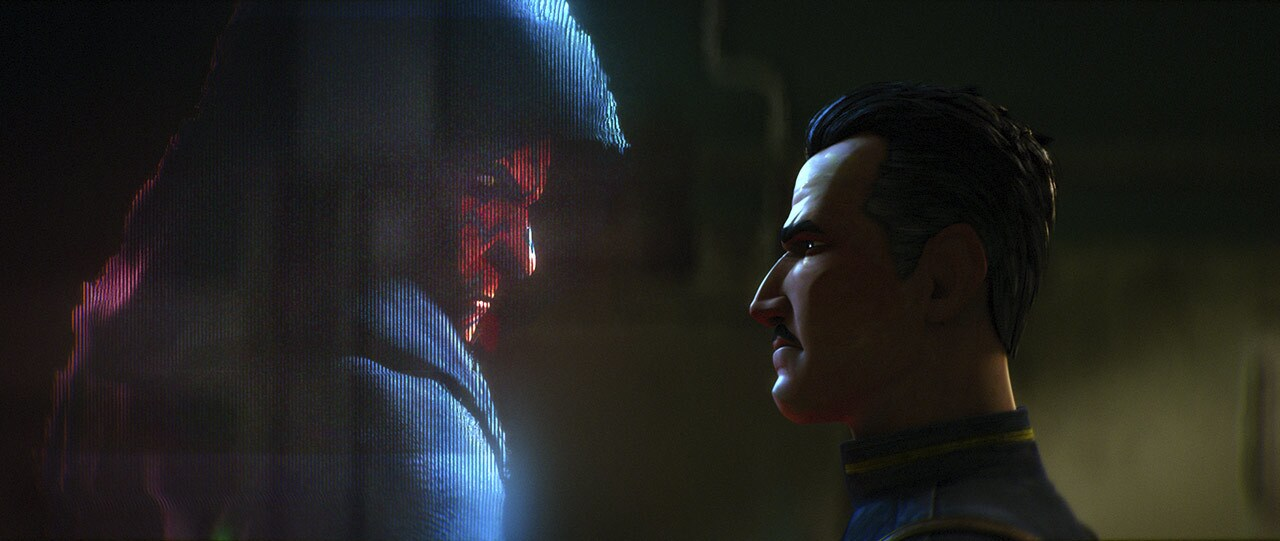
Lucasfilm has an interesting habit of producing Star Wars TV shows whose main characters are far less interesting than the worlds they inhabit and the people they encounter. We saw this with The Mandalorian, we saw it with The Bad Batch, and now we’re seeing it with Maul – Shadow Lord. Once again, the title character isn’t the main draw of this adventure, and once again, that’s fine. With its two-episode premiere on April 6, Maul – Shadow Lord is off to a promising start, with a great setting, a relatable hero, and an intriguingly vulnerable character caught between two worlds.
Maul – Shadow Lord establishes early on that it’s a different kind of Star Wars series, and the planet Janix and its main city are the perfect place to tell this story. I love the look of the place — busy, gritty, and simultaneously colorful and dark. Lucasfilm Animation put a lot of work into designing Janix, and I’d say it paid off. At first glance, it evokes Coruscant, but on closer inspection, it’s different enough from the galactic capital planet that it exudes an energy of its own. Whereas Coruscant is mostly built down into thousands of underlevels and has a skyscraper-clogged surface that defies engineering logic, Janix has a more grounded, less vertiginous urban landscape.
The show’s grounded visuals are an essential companion to its grounded story, which is another area in which it excels. Star Wars hasn’t done nearly enough stories focused on the criminal underworld, so this show’s whole vibe and premise are really exciting and refreshing. The first two episodes are peppered with authentic crime and noir tropes — the coffee-guzzling investigator, the wary underworld bosses meeting to clear the air — that help sell the tone of the show. (I particularly enjoyed seeing the bosses eating Star Wars’s version of chicken parmesan, which works well as a nod to the Italian-restaurant settings of many such meetings in crime movies.)
This great world-building continues through the character of Captain Brander Lawson, the Janix police investigator who becomes Maul’s bête noire. Lawson fits an archetype that we rarely see in Star Wars: a disenchanted everyman hero, a gruff but honorable law enforcer in a dangerous world on the galaxy’s periphery. Star Wars’s writing is often one of its biggest weaknesses, but Lawson’s dialogue (aided by voice actor Wagner Moura’s performance) fits perfectly into the show’s noir theme and almost immediately earns him the audience’s support and sympathy.
In keeping with the show’s more grounded theme, the second episode gives us a brief but compelling glimpse of Lawson’s messy home life. After years spent as a workaholic detective, he’s estranged from his wife and rarely has quality time to spend with his son Rylee. We so rarely see domestic scenes like this in Star Wars that it’s always a treat when one appears and it’s done well. The brief sequence in the Lawsons’ apartment does a great job of illustrating why our hero’s family life has fallen apart, which makes it all the more sad when we see him once again put his job first.
In these first two episodes, that job puts Lawson on a collision course with a force beyond his comprehension: the former Sith apprentice, former crime lord, and current vengeance cyclone Maul. While I maintain, as I said above, that Maul isn’t a very interesting villain, Maul – Shadow Lord gives him enough to work with that he and his schemes are still entertaining to watch.
For someone who started out as a blunt, impulsive instrument of someone else’s agenda, Maul has become remarkably careful and cunning in his years underground. In The Phantom Menace, Darth Sidious had to counsel patience as Maul yearned to reveal himself to the Jedi. In the decades since then, Maul has learned the value of subtlety and the hidden hand, telling his Mandalorian lieutenant Rook Kast that he intends to operate as “a shadow” on Janix. And at first, we see exactly that, as Maul, a perceptive observer of less sophisticated beings, deftly exploits the paranoia and anger of Janix crime lords Looti Vario and Nico Deemis to pit them violently against each other.
But as cunning as he is, Maul hasn’t completely shed his old self. After Vario escapes Maul’s trap, Maul refuses to let him get away and takes a huge risk by kidnapping him from the police headquarters. Later, Maul takes another big risk by confronting the fugitive Jedi Master Eeko-Dio Daki after Daki sabotages Maul’s getaway. These aren’t the chess moves of a patient mastermind; they’re the actions of a ruined man obsessed with vengeance. I appreciate seeing these flashes of Maul’s primal nature underneath his mask of composure.
Maul’s chance (or fated?) encounter with Daki’s Padwan, Devon Izara, creates a really interesting storytelling opportunity, as the disillusioned former Sith tries to convince the isolated Jedi to abandon what he sees as her counterproductive and obsolete dogma. Maul is at his best and most compelling as a character when he’s trying to corrupt someone with his seductive rhetoric (longtime Star Wars fans might remember him trying to recruit Ezra Bridger to the dark side in Star Wars Rebels), and the dynamic between him and Izara promises to offer a whole lot of that.
“Times have changed,” Maul tells Izara. “What does it mean for you to be a Jedi — guardian of peace and justice in a time of lawlessness?” As malevolent as Maul is, he’s right that this era represents an existential challenge for all surviving Jedi. How do these Jedi uphold their Order’s ideals in a galaxy where almost everyone hates them, where even the people who most need their help might sell them out to a government that wants to kill them? The galaxy of the Republic era was already full of moral quandaries for these scrupulously ethical Force monks, but the galaxy of the Imperial era is much more fraught with peril.
Izara tells Maul that she still believes in the principles of the Jedi Order, but we’ll see how long that lasts. She might have broken out of her cell by the end of episode 2, but I doubt that’s the end of her time with Maul. She’s surely reflecting on what Maul said about her being indoctrinated by the Jedi and needing to adapt to life without the protection of the Order. Whatever she encounters next, I have a feeling it will lead her to revisit Maul’s warnings.
Izara’s story is a fascinating look at how a lonely Jedi confronts moral choices — from the big (joining Maul) to the small (stealing food to survive) — in this era. Maul represents a test of Izara’s faith in the Force, and I can’t wait to see how she handles it.
When Maul’s underling Kast asks him what he plans to do with Izara, he reveals a long-term plan that could take this show from the galactic periphery all the way to Coruscant. For now, Maul is focused on getting revenge on the crime bosses who betrayed him. But on the horizon, Maul sees a bigger prize: his equally treacherous former master, Darth Sidious. Maul tells Kast that he’s going to turn Izara into a weapon who will help him destroy all of his enemies, including Sidious. Of course, he tried that once before, with his brother Savage Opress, and he failed miserably, getting Opress killed in the process. But Maul never forgets a grudge, so it makes sense that he hasn’t given up his hope for vengeance.
But what will Maul do differently this time? The answer to that question could have profound implications for the people of Janix throughout this season of Maul – Shadow Lord.
Miscellaneous thoughts
- With “The Dark Revenge” and “Sinister Schemes,” this show continues the Star Wars tradition of absolutely pathetic episode names. This lack of effort was fine for the decidedly juvenile first season of The Clone Wars, but Star Wars television deserves better now.
- As if to underscore that the galaxy has moved on from the optimism of the Jedi, Eeko-Dio Daki’s admonition to Devon Izara that “We can always rely on the kindness of strangers” is almost immediately disproven, as a passerby rejects his plea for charity. Janix, it seems, isn’t the place for that kind of optimism.
- I like the dynamic of local police trying to keep the Empire from meddling in their affairs. Even on non-rebellious worlds, you can imagine a lot of reasons why local authorities would want to preserve their autonomy. Imperial stormtroopers aren’t exactly thoughtful, delicate criminal investigators. If you need answers, you don’t want the Empire stepping in with heavy-handed tactics and mucking things up.
- We don’t learn much about the sketchy alien Rheena Sul during Lawson’s meeting with her in episode 2, but it’s clear that she’s a font of underworld knowledge whose information isn’t free. Lawson having to lean on people like her is a great illustration of the unsavory complexities of his job.
- I appreciated how the first episode brought Izara and Lawson together. As their stories intersect, their personalities clash. Lawson is sympathetic but overworked, a cog in a judicial system that grinds on despite his misgivings. Izara, meanwhile, is headstrong and secretive after spending years in hiding. Lawson wants to treat her kindly, but she has no reason to believe that and refuses to talk to him. I wonder if that friction will have consequences in future episodes.
- I like the lore detail that the Imperial Security Bureau has classified Maul’s file and put out an APB for him. No doubt Emperor Palpatine would be immensely interested in information about his unruly former apprentice’s whereabouts.
- I almost laughed at Two-Boots saying he can’t find any data on the Shadow Collective. Yeah, buddy, that’s kind of the idea.
- Maul’s “Spybot” droid is supposed to be funny, but it’s just annoying. Either have your droid speak Basic or don’t, but don’t do this silly halfway thing where you can just barely make out his words.
- Looti Vario is a fun character. I like the clash between his and Deemis’s personalities; it adds a very authentic texture to this new noir flavor of Star Wars storytelling. As Maul’s prisoner, Vario exudes the really amusing energy of a smooth-talking weasel who isn’t sure which enemy to fear more.
- Episode 1 has two good musical homages: The brief snippet of Duel of the Fates when Maul first shows up, and the music in the speeder chase sequence, which evokes (and at one point seems to directly copy) the music from the Attack of the Clones speeder chase.